Blogs
Best Dedicated Server Guide for Maximum Performance in 2026
March 30, 2026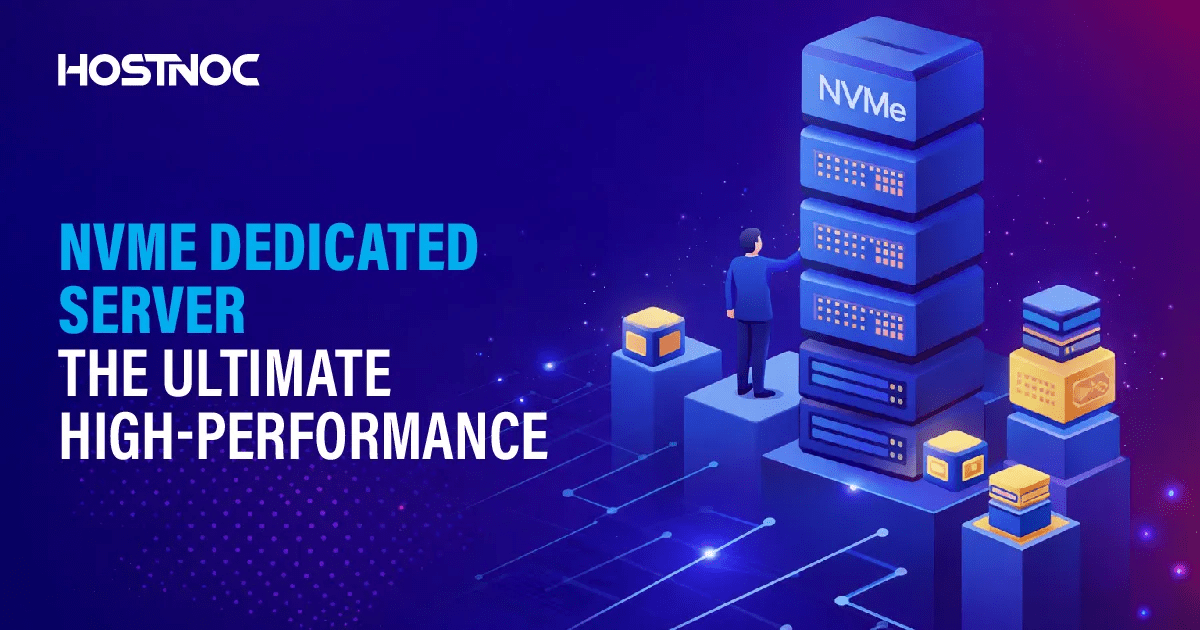
Web applications, databases, AI workloads, and high-traffic eCommerce platforms are generating more data than ever. Traditional HDD and even SATA SSD servers struggle with IOPS bottlenecks, latency spikes, and inconsistent throughput under heavy load.
Slow disk performance means delayed API responses, abandoned shopping carts, ranking drops in search engines, and degraded user experience. For mission-critical platforms, milliseconds translate directly into lost revenue and operational risk.
An NVMe dedicated server delivers ultra-low latency, massive parallelism, and dramatically higher I/O throughput by leveraging NVMe storage over the PCIe bus. If your workload is performance-sensitive, data-intensive, or mission-critical, NVMe dedicated hosting is the most scalable and future-ready infrastructure choice.
Table of Contents
- What Is an NVMe Dedicated Server?
- How Does NVMe Compare to SATA SSD and HDD?
- Why Is NVMe Ideal for High-Performance Workloads?
- What Types of Applications Benefit Most from NVMe Dedicated Servers?
- How Does a Dedicated Server Improve Security and Control?
- What Hardware Components Complement NVMe Storage?
- When Should You Upgrade to an NVMe Dedicated Server?
- What Are the Key Benefits of NVMe Dedicated Hosting?
- Are There Any Drawbacks to Consider?
- How Does NVMe Impact SEO and User Experience?
- Is NVMe Dedicated Hosting Future-Proof?
- Final Verdict:
What Is an NVMe Dedicated Server?
An NVMe dedicated server is a physical server exclusively allocated to a single client and equipped with Non-Volatile Memory Express (NVMe) solid-state drives. Unlike shared hosting or VPS solutions, all hardware resources CPU, RAM, storage, and bandwidth are fully dedicated.
NVMe is a storage protocol designed specifically for flash memory. It connects directly via PCIe lanes rather than older SATA interfaces, enabling significantly lower latency and higher input/output operations per second (IOPS).
In practical terms, this means:
- Faster database queries
- Near-instant data retrieval
- Reduced bottlenecks under high concurrency
- Superior performance for virtualization and AI workloads
How Does NVMe Compare to SATA SSD and HDD?
Understanding the evolution of storage helps clarify why NVMe is transformative.
HDD (Hard Disk Drive)
- Mechanical spinning disks
- High latency (milliseconds)
- Limited IOPS
- Bottlenecks under heavy load
SATA SSD
- Flash storage
- Lower latency than HDD
- Limited by SATA interface (~600 MB/s ceiling)
NVMe SSD
- Flash storage over PCIe
- Parallel command queues (up to 64K queues)
- Extremely low latency (microseconds)
- Multi-GB/s throughput
For example, NVMe drives built on PCIe Gen4 can outperform SATA SSDs by several multiples in both throughput and IOPS.
Why Is NVMe Ideal for High-Performance Workloads?
Here are some reasons why an NVMe dedicated server is an ideal choice for high-performance workloads.
1. Massive Parallelism
NVMe was designed for modern multi-core CPUs like those from Intel and AMD. It allows thousands of simultaneous command queues, aligning with today’s high-core processors.
2. Ultra-Low Latency
Latency is often the hidden performance killer. NVMe drastically reduces round-trip storage latency compared to SATA.
3. High IOPS for Databases
Applications running MySQL, PostgreSQL, or MongoDB benefit significantly from faster random reads/writes.
4. Better Virtualization Performance
Virtual machines on platforms like VMware or containerized deployments using Docker achieve improved disk responsiveness.
What Types of Applications Benefit Most from NVMe Dedicated Servers?
Each workload category experiences unique advantages:
High-Traffic eCommerce
Platforms such as Magento and WooCommerce require fast database and cache access to handle peak traffic.
SaaS Platforms
Software-as-a-Service providers benefit from low latency and consistent performance under concurrent usage.
Big Data & Analytics
Data pipelines, indexing systems, and real-time analytics engines process millions of I/O operations per second.
AI & Machine Learning
Training models with frameworks such as TensorFlow or PyTorch requires high-speed access to datasets.
Gaming Servers
Multiplayer game servers rely on rapid state updates and low response times.
How Does a Dedicated Server Improve Security and Control?
Unlike shared hosting, a dedicated server offers:
- Isolated hardware environment
- Custom firewall configurations
- Full root access
- Compliance-friendly infrastructure
Organizations dealing with regulated data often prefer dedicated hardware for compliance standards such as HIPAA or PCI DSS.
What Hardware Components Complement NVMe Storage?
NVMe storage performs best when paired with powerful supporting hardware:
High-Core CPUs
Processors like the AMD EPYC or Intel Xeon provide the parallel processing power NVMe thrives on.
ECC RAM
Error-correcting memory ensures reliability for mission-critical workloads.
PCIe Gen4 / Gen5 Support
Modern PCIe standards maximize NVMe throughput.
RAID Configurations
NVMe RAID (via software or hardware controllers) enhances redundancy and performance scaling.
When Should You Upgrade to an NVMe Dedicated Server?
Consider upgrading if:
- Your database queries exceed 5–10 ms regularly
- You experience I/O wait bottlenecks
- Your application scales horizontally but still struggles
- You operate latency-sensitive systems (fintech, trading, gaming)
- Your analytics workloads are disk-bound
What Are the Key Benefits of NVMe Dedicated Hosting?
Performance
Dramatically higher IOPS and throughput.
Reliability
Fewer mechanical failures compared to HDD.
Scalability
Handles high concurrency and growth seamlessly.
Competitive Advantage
Improved user experience translates to higher retention and revenue.
Are There Any Drawbacks to Consider?
While NVMe dedicated servers offer superior performance, consider:
- Higher cost compared to SATA servers
- Overkill for low-traffic or static websites
- Requires proper configuration to maximize performance
For lightweight blogs or small informational websites, NVMe may not provide proportional ROI.
How Does NVMe Impact SEO and User Experience?
Search engines prioritize page speed and Core Web Vitals. Faster disk performance reduces:
- Time to First Byte (TTFB)
- Backend processing time
- Database response delays
This indirectly improves search ranking potential and user retention.
Is NVMe Dedicated Hosting Future-Proof?
Yes, NVMe is the standard for next-generation storage architectures. As PCIe continues evolving (Gen4 → Gen5 → Gen6), NVMe drives will scale accordingly.
Enterprises adopting NVMe infrastructure position themselves for:
- AI expansion
- Real-time analytics
- High-frequency transactional systems
- Large-scale container orchestration
Final Verdict:
If your operations are data-intensive, revenue-critical, or performance-sensitive, an NVMe dedicated server is not a luxury; it’s infrastructure insurance.
It eliminates I/O bottlenecks, maximizes hardware utilization, and supports modern workloads built on databases, virtualization, AI, and large-scale web platforms.
For high-growth businesses, SaaS companies, fintech firms, and enterprise applications, NVMe dedicated hosting provides the performance ceiling necessary to compete in today’s digital landscape.

Featured Post
Best Dedicated Server Guide for Maximum Performance in 2026
A dedicated server gives you an entire physical server with 100% exclusive resources, no sharing CPU, RAM, or storage with anyone else. It is the best […]

saad ullah
March 30, 2026
Dedicated Server for Big Data Analytics: Architecture, Performance, and Deployment at Scale
Big data analytics workloads place extreme and non-negotiable demands on infrastructure. High-throughput ingestion, parallel computation, memory-intensive processing, and sustained disk I/O are not optional features—they are […]

Sarmad Hasan
March 21, 2026
Dedicated Server with Root Access: Everything You Need to Know
A dedicated server with root access is a physical server exclusively allocated to a single user or organization, providing complete administrative control over the operating system, […]
Sarmad Hasan
March 16, 2026