Blogs
on
Dedicated Server with Root Access: Complete 2026 Breakdown
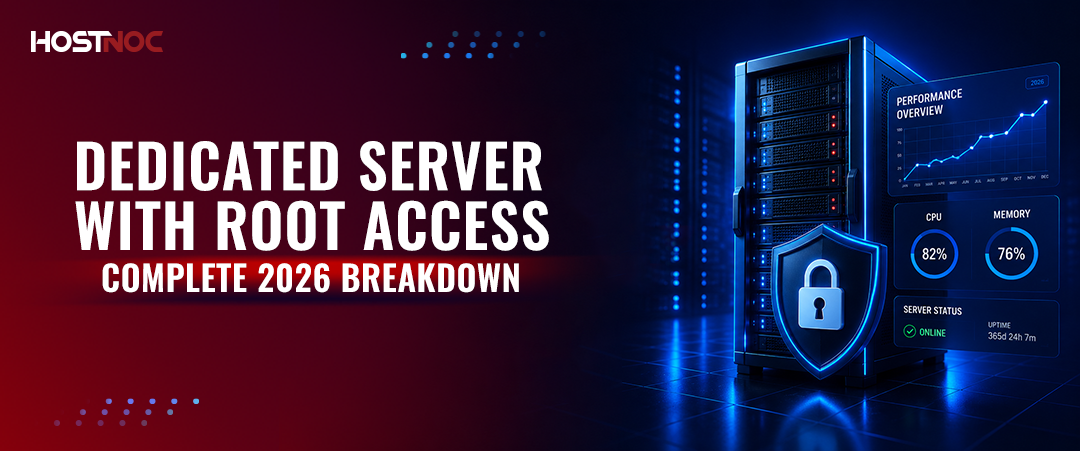
A dedicated server with root access gives you full administrative control over a physical machine, with no shared tenants and no provider-imposed restrictions. You can install any software, tune the kernel, configure firewalls, and manage storage exactly as your workload requires, making it the top choice for high-traffic, compliance-driven, or performance-critical applications.
A dedicated server with root access gives you full administrative control over a physical machine, with no shared tenants and no provider-imposed restrictions. You can install any software, tune the kernel, configure firewalls, and manage storage exactly as your workload requires, making it the top choice for high-traffic, compliance-driven, or performance-critical applications.
Key Takeaways:
- Root access is the highest privilege level on Linux servers (the equivalent on Windows is the Administrator account), giving full control over files, services, and the kernel.
- A dedicated server reserves 100% of CPU, RAM, storage, and bandwidth for one tenant, eliminating the “noisy neighbor” problem common in VPS and cloud environments.
- Root access is essential for kernel tuning, custom firewall rules, RAID and LVM configuration, and compliance frameworks like PCI DSS and HIPAA.
- Most unmanaged dedicated servers include root access by default, while managed plans may restrict it based on support scope.
- With root access comes full administrative responsibility, including patching, monitoring, and security hardening.
- Compared to VPS or cloud instances, dedicated servers offer more predictable performance but typically cost more per month.
What Is Root Access, Exactly?
Root access refers to the highest level of administrative privilege on a server, most commonly associated with Linux-based operating systems such as Ubuntu Server, CentOS, Debian, AlmaLinux, and Rocky Linux. With root-level permissions, the server owner can install, modify, or remove any system files, configure kernel parameters, manage user permissions, and deploy custom software without restrictions imposed by the hosting provider.
On Windows-based dedicated servers, the equivalent role is the Administrator account, which grants the same operating-system-level authority. In both cases, this account can read, write, and execute any system resource, which is why it’s treated as a high-trust credential that should be limited to experienced system administrators.
Do you get root access automatically? In most unmanaged dedicated server plans, full root access is included by default at no extra cost. Managed plans, however, may limit it depending on the support tier or control panel (such as cPanel or Plesk) included with the server. Always confirm the access level before signing up, since some providers reserve certain kernel-level changes for their own support team even on “dedicated” plans.
Dedicated Server vs. VPS vs. Cloud: Root Access Compared
Choosing among a dedicated server, a VPS, and a cloud instance often comes down to how much control and isolation your workload actually needs. The table below summarizes the practical differences.
| Feature | Shared Hosting | Cloud VPS | Dedicated Server |
| Root access available | No | Yes, but limited by the provider | Yes, full and unrestricted |
| Resource isolation | None (shared with many sites) | Partial (shared physical host) | Complete (entire machine reserved) |
| Kernel-level tuning | Not possible | Often restricted | Fully configurable |
| Custom RAID/LVM setup | Not possible | Limited | Fully configurable |
| Typical use case | Small blogs, basic sites | Startups, scalable apps | High-traffic platforms, compliance-heavy workloads |
| Monthly cost | Lowest | Low to moderate | Highest, but fixed and predictable |
| Admin responsibility | Provider-managed | Shared or self-managed | Fully self-managed (unless on managed plan) |
Cloud VPS hosting typically offers root access, but providers often limit certain system-level changes to preserve the stability of the shared physical host underneath. A dedicated server removes that ceiling entirely, since there’s no underlying hypervisor layer to protect from other tenants.
Must learn about these comparisons: Dedicated Server vs Cloud Server & Shared Vs Dedicated Hosting
Managed vs. Unmanaged Dedicated Server with Root Access
Even within dedicated server hosting, root access works differently depending on whether you choose a managed or unmanaged plan. Understanding this distinction helps you pick the right level of support for your team’s skill set.
| Feature | Managed | Unmanaged |
| Root access | Usually available, sometimes with limits | Full, unrestricted access |
| Server maintenance | Handled by the provider | Handled by the customer |
| Security patching | Provider-managed | Customer-managed |
| Monitoring | Included by the provider | Customer sets up own tools |
| Best for | Businesses without dedicated sysadmins | Experienced administrators and DevOps teams |
Businesses without dedicated IT staff often choose managed dedicated servers, while development teams and system administrators typically prefer unmanaged servers with unrestricted root access. The right choice depends less on budget and more on whether your team has the expertise (and time) to handle patching, monitoring, and incident response in-house. Learn managed vs unmanaged server comparison to know which one is truly better?
Who Should Invest in a Dedicated Server with Root Access?
Dedicated servers with root access are widely used by enterprises, SaaS providers, high-traffic websites, game server operators, data analytics firms, and organizations with strict compliance requirements. These environments demand predictable performance, deep customization, and full control over infrastructure, which cannot be achieved with managed or shared hosting solutions.
If your team needs to install specialized software, tune database engines beyond default settings, or meet audit requirements that call for documented system-level controls, a dedicated server with root access is generally the right fit. If your needs are limited to standard web hosting with occasional plugin installs, a managed VPS or shared plan may be more cost-effective.
Organizations evaluating infrastructure control may also benefit from understanding the differences between a dedicated server and VPS hosting, particularly when root access requirements become a deciding factor.
Signs You Need a Dedicated Server with Root Access
Not sure whether root access is a requirement for your project or just a nice-to-have? If any of the following apply to your situation, a dedicated server with root access is likely the right choice.
- You need to install custom software that isn’t supported by standard hosting plans.
- Your application requires kernel-level tuning for performance or stability.
- Compliance frameworks require documented, auditable system controls.
- Database workloads need custom configuration beyond default buffer pools and query caches.
- You want full control over security policies, firewall rules, and intrusion detection.
- Virtualization or Kubernetes deployment requires unrestricted administrative access.
- Shared hosting limitations are already affecting your application’s performance or scalability.
If none of these apply yet, a managed VPS may still cover your needs. But if you’re checking off two or more of these, root access on a dedicated server will likely save time and prevent future migrations.

Advantages of a Dedicated Server with Root Access
Guaranteed Hardware Isolation
One of the primary advantages of a dedicated server with root access is guaranteed hardware isolation. Since no other tenants share the system, workloads are not affected by the “noisy neighbor” problem common in VPS or cloud environments. This makes dedicated servers ideal for CPU-intensive applications, memory-heavy databases like MySQL and PostgreSQL, and high-IOPS storage workloads.
Full Kernel and System-Level Control
Root access allows complete control over the operating system kernel and system services. Administrators can tune kernel parameters such as swappiness, file descriptor limits, TCP buffer sizes, and scheduler behavior to optimize performance for specific applications. This level of tuning is critical for high-frequency trading platforms, real-time analytics engines, and low-latency APIs.
For example, raising the file descriptor limit (ulimit) lets a high-concurrency API handle thousands of simultaneous connections without hitting “too many open files” errors, a change that requires root-level access to /etc/security/limits.conf or to sysctl settings.
Enterprise-Grade Hardware Configuration
Dedicated servers commonly support enterprise-grade hardware components such as Intel Xeon or AMD EPYC processors, ECC RAM, NVMe SSDs, and hardware RAID controllers. Root access enables direct configuration of RAID levels, disk partitioning, logical volume management (LVM), and file systems like ext4, XFS, or ZFS based on performance and redundancy needs.
Stronger Security and Compliance Control
Security control is a major reason organizations choose a dedicated server with root access. Administrators can configure firewalls using iptables, nftables, or firewalld, deploy intrusion detection systems like Fail2Ban or OSSEC, and enforce custom SELinux or AppArmor policies. This granular control is essential for meeting standards such as PCI DSS, HIPAA, SOC 2, and ISO 27001.
Compliance frameworks generally require documented proof of how systems are configured, monitored, and restricted. Without root access, you depend on the provider’s default configuration and may not be able to demonstrate the access controls auditors expect.
Freedom to Run Any Software Stack
With root privileges, administrators can deploy any web server or application stack. Popular configurations include the LAMP stack (Linux, Apache, MySQL, PHP), LEMP stack (Linux, Nginx, MySQL, PHP-FPM), Node.js environments, Python frameworks like Django and Flask, and containerized workloads using Docker or Podman. Root access also lets you install specific runtime versions, custom kernel modules, or GPU drivers that aren’t part of a provider’s default image.
Use Cases for a Dedicated Server with Root Access
Database Hosting
Dedicated servers with root access are often used for database hosting due to their predictable performance. Administrators can fine-tune database engines such as MySQL, MariaDB, MongoDB, or Elasticsearch by adjusting buffer pools, query caches, replication settings, and storage engines. This level of optimization is not possible in restrictive hosting environments, where buffer pool sizes and connection limits are often fixed by the provider.
Game Server Hosting
Game server hosting is another common use case for a dedicated server with root access. Multiplayer platforms for games like Minecraft, Counter-Strike, Rust, and ARK require full control over ports, mods, server binaries, and resource allocation. Root access ensures stable tick rates, mod compatibility, and protection against DDoS attacks. Real-time platforms also benefit from root-level process scheduling, which lets administrators prioritize the game server process over background tasks to reduce latency spikes.

Virtualization and Container Orchestration
Root access also enables advanced virtualization and container orchestration. Administrators can deploy KVM, Xen, or VMware ESXi to create private virtual machines or run Kubernetes clusters directly on bare metal. Bare-metal Kubernetes provides higher performance and lower latency compared to cloud-based nodes, since there’s no nested hypervisor overhead.
Networking Customization
Networking customization is a significant benefit of dedicated servers. With root access, users can configure custom routing tables, VLAN tagging, bonding (link aggregation), and IPv6 networking. This is particularly valuable for content delivery networks, VoIP services, and large-scale distributed applications that need granular control over how traffic enters and leaves the server.
Backup and Disaster Recovery
Dedicated server with root access supports custom backup and disaster recovery strategies. Administrators can configure snapshot-based backups, incremental rsync jobs, offsite replication, or object storage integration with platforms like Amazon S3-compatible services. Full control ensures backups align precisely with business recovery objectives, including custom retention schedules required by compliance audits.
Enterprise Applications (ERP and CRM)
Enterprise systems such as ERP or CRM platforms rarely run on default configurations. These applications often integrate with internal services, legacy tools, and secure networks, which means administrators need to deploy custom middleware, configure internal authentication mechanisms (such as LDAP or Active Directory integration), and set resource allocation policies that match corporate IT standards rather than a provider’s defaults.
High-Traffic eCommerce
For high-traffic eCommerce platforms, even small delays in checkout processing can affect revenue, especially during seasonal sales when traffic spikes several times over baseline. Root access lets teams tune database behavior for checkout transactions, optimize caching layers, configure session storage isolation, and apply rate-limiting policies at the system level to protect checkout endpoints from abuse.
Example Dedicated Server Configurations
Hardware requirements vary significantly depending on workload. The examples below illustrate typical configurations for common use cases.
Entry-Level Web Hosting Server
- AMD Ryzen 7 processor
- 32 GB RAM
- 1 TB NVMe SSD
- 1 Gbps network port
- Ubuntu Server
Business Application Server
- AMD EPYC 7313 processor
- 128 GB RAM
- 2 x NVMe SSD in RAID 1
- AlmaLinux
Enterprise Database Server
- AMD EPYC 9654 processor
- 512 GB RAM
- NVMe RAID array
- 10 Gbps network
- Rocky Linux
These configurations are starting points. The right specification depends on factors like concurrent user load, database size, and whether the workload is CPU-bound, memory-bound, or I/O-bound.
Dedicated Server with Root Access for Different Industries
Root access requirements look different depending on the industry and the regulatory or performance demands involved.
| Industry | Common Use Cases |
| Healthcare | Compliance-driven hosting, patient data systems, HIPAA-aligned configurations |
| Finance | Trading platforms, fraud detection and analytics, and low-latency processing |
| SaaS | Custom application hosting, multi-tenant architecture, API infrastructure |
| eCommerce | High-traffic online stores, checkout optimization, PCI DSS compliance |
| Gaming | Multiplayer game servers, mod support, low-latency networking |
| Education | Research environments, computational labs, sandboxed testing |
Root Access Security Best Practices
Root access is powerful, which means security hygiene matters more than on a restricted hosting plan. The following practices form a baseline for any production server.
- Disable direct root SSH login and require authentication through a separate administrative account with sudo privileges.
- Use SSH key authentication instead of passwords.
- Enable multi-factor authentication for administrative access where possible.
- Restrict access through firewall rules, allowing only necessary ports and trusted IP ranges.
- Monitor login activity and configure alerts for failed or unusual login attempts.
- Rotate credentials and SSH keys on a regular schedule.
- Keep the operating system and installed software updated with security patches.
Popular Operating Systems for Dedicated Server with Root Access
Root access behaves slightly differently depending on the operating system. Here’s how the most common options compare.
Ubuntu Server: Popular for web hosting, DevOps workflows, and containerized deployments, thanks to frequent updates and broad community support.
Debian: Known for long-term stability and a conservative update cycle, making it a common choice for production servers that prioritize predictability over the newest packages.
AlmaLinux and Rocky Linux: Enterprise-focused distributions that emerged as popular alternatives after CentOS shifted its release model, widely used in business and database hosting environments.
Windows Server: Provides Administrator-level access instead of Linux root access, used for environments running .NET applications, Microsoft SQL Server, or Active Directory integration.
Common Mistakes When Using Root Access
Even experienced teams run into avoidable problems with root-level control. Watching for these issues early helps prevent downtime and security gaps.
- Using the root account for daily tasks. Logging in directly as root for routine work increases the risk of accidental, system-wide changes. Best practice is to create a separate administrative user with sudo privileges and reserve root login for specific maintenance tasks.
- Skipping firewall configuration. A freshly provisioned server with root access and no firewall rules is an open target. Configure iptables, nftables, or firewalld immediately after provisioning, before deploying any application.
- Neglecting OS updates and security patches. Unlike managed hosting, a self-managed dedicated server places patching responsibility entirely on the user. Set up automated security updates or a regular patching schedule from day one.
- Over-tuning kernel parameters without testing. Aggressive sysctl changes (such as swappiness or TCP buffer sizes) can improve performance for one workload while degrading another. Test changes in a staging environment before applying them to production.
- No documented access logs. For compliance frameworks like PCI DSS or HIPAA, every root-level action should be logged and auditable. Configure command auditing (such as auditd on Linux) early rather than retrofitting it later.
- Ignoring backup verification. Having root access to configure backups doesn’t guarantee they work. Regularly test restore procedures, not just backup completion.
Expert Insights: Getting the Most from Root Access
Experienced system administrators generally recommend a layered approach to root-level management. Rather than treating root as a single all-or-nothing switch, teams should combine it with role-based access controls (using sudo with granular permissions), centralized logging, and configuration management tools like Ansible or Terraform so that system changes are version-controlled and repeatable.
Performance tuning is most effective when it’s data-driven. Before changing kernel parameters, review metrics from tools like iostat, vmstat, and /proc to identify the actual bottleneck rather than applying generic “performance tuning” guides that may not match your workload’s behavior. A database server under heavy write load, for instance, often benefits more from filesystem mount options and I/O scheduler tuning than from CPU-level changes.
For security, the principle of least privilege still applies even with root access available. Just because root can do everything doesn’t mean every process or user account should run with elevated privileges. Many breaches stem from unnecessary services running as root rather than the root account itself being compromised.
Cost, Scalability, and Responsibility
Unlike managed hosting, a dedicated server with root access places responsibility for system administration on the user. Tasks such as OS updates, security patching, service monitoring, and log management must be handled internally. This makes a dedicated server with root access best suited for experienced system administrators or DevOps teams, or for businesses that pair an unmanaged server with a managed services add-on.
Cost structure is another distinguishing factor. Dedicated servers typically have higher monthly costs than VPS or cloud instances, but they offer fixed pricing without variable usage fees. For workloads with constant, predictable demand, dedicated servers can be more cost-effective than cloud infrastructure over time, since cloud bills often scale with usage spikes.
Scalability in a dedicated server environment is achieved through vertical scaling or horizontal expansion. Vertical scaling involves upgrading CPU, RAM, or storage on the existing machine, while horizontal scaling requires adding more dedicated servers behind load balancers such as HAProxy or Nginx. Root access ensures full control over how that scaling architecture is built, including custom health checks and failover logic.
A dedicated server with root access can also be deployed in data centers across various geographic regions. This allows businesses to comply with data residency laws, reduce latency for regional users, and build multi-location redundancy strategies without relying on hyperscale cloud providers.
Typical Dedicated Server with Root Access Pricing
Pricing for a dedicated server with root access depends heavily on hardware specifications and management level. The table below outlines typical monthly cost ranges.
| Configuration | Monthly Cost Range |
| Entry-Level Dedicated Server | $80 – $150 |
| Business Dedicated Server | $150 – $300 |
| High-Performance NVMe Server | $300 – $800 |
| Enterprise Dedicated Server | $800 – $2,000+ |
Pricing varies based on CPU generation, RAM capacity, storage type, bandwidth allocation, and whether the server is managed or unmanaged. Managed plans typically add a premium of $50 to $200 per month over an equivalent unmanaged configuration, reflecting the provider’s added patching, monitoring, and support workload.
Conclusion
A dedicated server with root access provides unmatched control, performance, and customization for demanding workloads. It is the preferred solution for organizations that require full ownership of their infrastructure, deep system-level optimization, and strict security control. While it requires technical expertise and ongoing administrative responsibility, the flexibility and power a dedicated server with root access offers make it a cornerstone of enterprise and high-performance hosting strategies.
Frequently Asked Questions About Dedicated Server with Root Access

What is the difference between root access and admin access?
Root access is the Linux/Unix term for the highest level of system privilege, while “Administrator” is the equivalent role on Windows servers. Both grant full control over the operating system, files, and installed software.
Do all dedicated servers come with root access?
Most unmanaged dedicated server plans include full root access by default. Managed plans may restrict certain root-level changes depending on the provider’s support scope, so it’s important to confirm this before purchasing.
Is root access safe to use?
Root access itself is safe when managed correctly. Risks come from misconfiguration, weak SSH security, or running daily tasks as root instead of using a limited account with sudo privileges. Following security best practices keeps root access safe.
Can I get root access on a VPS instead of a dedicated server?
Yes, most VPS plans include root access to the virtual server. However, since a VPS shares the underlying physical host with other tenants, providers often restrict certain kernel-level or hardware-related changes that a dedicated server allows.
What can I do with root access that I can't do without it?
Root access lets you modify kernel parameters, install any software package, configure firewalls and RAID, manage user permissions, and access all system files. Without it, you’re limited to user-level configurations within whatever the provider allows.
Do I need root access for a simple WordPress site?
Generally no. A managed hosting plan or shared hosting is usually sufficient for a standard WordPress site. Root access becomes valuable when you need custom server software, specific performance tuning, or compliance-driven configurations.
How do I secure a dedicated server with root access?
Key steps include disabling direct root SSH login, using key-based authentication, configuring a firewall, installing intrusion detection tools like Fail2Ban, keeping the OS patched, and limiting which accounts have sudo privileges.
Is a dedicated server with root access good for compliance like PCI DSS or HIPAA?
Yes. Root access lets administrators configure the access controls, logging, and monitoring that these frameworks require, and provides the documentation needed to demonstrate compliance during an audit.
What operating systems support root access?
Root access is standard on Linux distributions such as Ubuntu Server, CentOS, Debian, AlmaLinux, and Rocky Linux. Windows servers use an equivalent Administrator account with comparable system-level privileges.
How much does a dedicated server with root access cost?
Pricing typically ranges from $80 to $150 per month for entry-level servers, $150 to $300 for business-grade configurations, $300 to $800 for high-performance NVMe servers, and $800 to $2,000 or more for enterprise setups. Final cost depends on CPU generation, RAM, storage type, bandwidth, and whether the plan is managed or unmanaged.
What's the difference between a managed and an unmanaged dedicated server with root access?
A managed dedicated server includes provider-handled maintenance, patching, and monitoring, often with some root access limitations. An unmanaged dedicated server gives you full, unrestricted root access but places all maintenance, security, and monitoring responsibility on your team.
Can I switch from a VPS to a dedicated server later?
Yes, most providers support migration paths from VPS to dedicated server hosting. However, since dedicated servers are physical machines, migration involves moving data and configurations to new hardware rather than a simple resource upgrade.
What happens if I misconfigure something with root access?
Misconfigurations can range from minor service disruptions to a server becoming unbootable. This is why testing changes in a staging environment, maintaining backups, and documenting configuration changes are essential practices when working with root-level access.

Featured Post
Dedicated Server for Agencies: A Complete Guide
Agencies today manage multiple client websites, applications, and...

Sarmad Hasan
July 13, 2026
Does Borderlands 3 Have Dedicated Servers?
No. Borderlands 3 does not use dedicated servers. Multi player gaming sessions...

saad ullah
July 8, 2026
Data Center Market Share 2026: Hyperscalers vs. Colocation vs. Enterprise
The global data center industry is undergoing one of the most significant...
Sarmad Hasan
July 1, 2026