


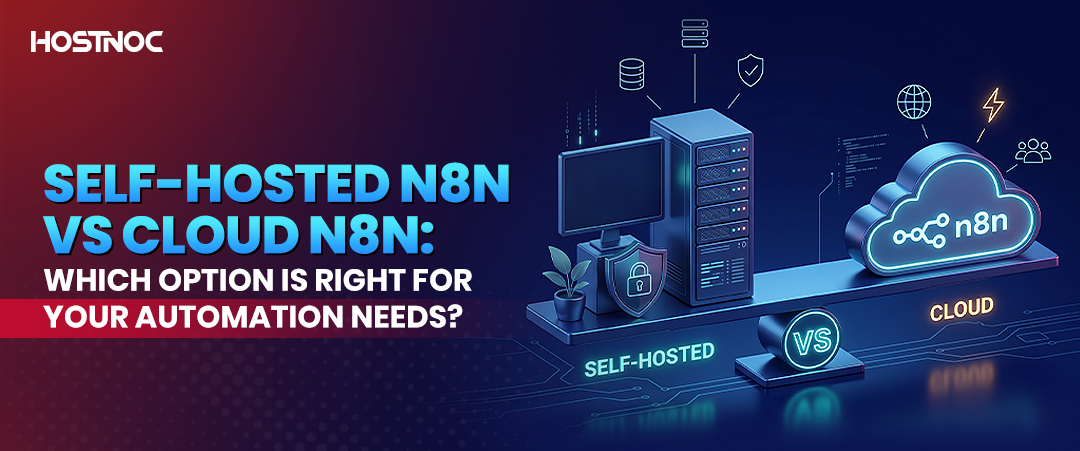
Key Takeaways:
- Self-hosted n8n offers complete ownership over your automation environment, databases, credentials, workflows and infrastructure, making it ideal for organizations with strict security, compliance or customization requirements.
- Cloud n8n prioritizes convenience, allowing teams to start building workflows immediately without worrying about server management, updates, backups, monitoring or scaling infrastructure.
- The total cost differs significantly depending on scale. While self-hosting can reduce recurring subscription costs, infrastructure, maintenance, DevOps expertise and operational overhead must also be considered.
- Performance depends more on infrastructure than deployment model. A properly configured self-hosted instance can outperform cloud deployments for high-volume workflows but Cloud n8n automatically handles much of the operational complexity.
- Security responsibilities shift dramatically. Cloud n8n manages platform security, whereas self-hosted users are responsible for operating system hardening, backups, SSL certificates, access control, monitoring and disaster recovery.
Self-hosted vs cloud n8n is a decision every growing business eventually has to make once workflow automation becomes part of their daily operations. Organizations increasingly rely on automation platforms to connect applications like Slack, Google Workspace, Airtable, Salesforce, HubSpot, PostgreSQL, MySQL, Microsoft Teams, GitHub, Notion, Stripe, Shopify, and hundreds of other services — without writing large amounts of custom integration code.
Among today’s automation platforms, n8n has emerged as one of the most flexible solutions because it combines low-code workflow building with the ability to execute JavaScript, make HTTP requests, manipulate data, call APIs, and build highly customized automations. But before diving in, one of the first questions businesses face is: self-hosted vs cloud n8n — which setup actually fits their needs, budget, and technical resources?
One of the biggest advantages of n8n is that users can choose between two deployment models:
- Self-Hosted n8n
- Cloud n8n
Both provide access to the same workflow engine, they differ significantly in infrastructure ownership, scalability, maintenance responsibilities, pricing, customization capabilities, security, and long-term operational costs. Understanding these differences is essential before committing your automation platform to either deployment model
“Self-hosting gives you complete control — but with control comes responsibility.”
What is Self-Hosted n8n?
Self-hosted n8n means installing the workflow automation platform on infrastructure that you control. The application can run on a local server, virtual machine, VPS, Kubernetes cluster, Docker container, cloud virtual machine or enterprise data center. Instead of relying on n8n to manage your environment, your organization becomes responsible for the complete software stack including:
- Operating system
- Database
- SSL certificates
- Backup and disaster recovery
- Monitoring
- Updates
Many organizations deploy self-hosted n8n using Docker Compose because it simplifies installation while allowing PostgreSQL, Redis and reverse proxies such as Nginx or Traefik to be managed together. Larger enterprises often deploy n8n on Kubernetes clusters running on AWS, Microsoft Azure, Google Cloud Platform or on-premises VMware infrastructure.
“For businesses without a dedicated DevOps resource, cloud hosting often pays for itself in saved time.”
What is Cloud n8n?
Cloud n8n is the fully managed software-as-a-service (SaaS) offering maintained by the n8n team. If you’re still exploring what is n8n hosting and how it works, think of cloud n8n as the simplest starting point — instead of provisioning servers or configuring databases, users simply create an account and begin designing workflows through the browser.
Everything related to infrastructure including operating system maintenance, server monitoring, upgrades, storage management, SSL certificates and platform availability is handled by the service provider. This allows teams to focus exclusively on workflow development rather than DevOps. For startups, marketing agencies, freelancers and product teams, this dramatically shortens the time required to launch automation projects.
Infrastructure Management
The biggest distinction between self-hosted and cloud deployments is infrastructure ownership.
With self-hosted n8n, your organization manages every layer of the deployment stack. This includes provisioning servers, configuring PostgreSQL databases, setting up environment variables, implementing backup strategies, renewing SSL certificates, installing software updates, monitoring CPU and memory usage and troubleshooting system failures.
Cloud n8n eliminates these operational responsibilities. Users simply access the web interface while the provider manages hardware resources, software upgrades, storage optimization, redundancy and platform maintenance. Organizations without dedicated DevOps engineers generally find Cloud n8n significantly easier to operate because infrastructure complexity is abstracted away.
Setup and Deployment
Cloud deployment is considerably faster. Creating an account typically takes only a few minutes, after which users can begin building workflows immediately. Self-hosted deployments require considerably more preparation. Administrators must provision servers, configure networking, create databases, expose secure HTTPS endpoints, configure authentication and often integrate reverse proxies for secure external access.
In enterprise environments, deployment may also involve:
- Identity provider integration using OAuth or SAML for centralized authentication, ensuring employees can securely access automation tools through existing identity management systems.
- Internal firewall configuration to restrict administrative access, reducing the attack surface while allowing trusted internal systems to communicate with workflow services.
- Database clustering and replication for higher availability, protecting workflows against infrastructure failures and minimizing downtime during maintenance.
Even though the deployment complexity is higher, organizations gain significantly more architectural flexibility.
“Self-hosted n8n is powerful for teams that value data privacy and customization above ease of setup.”
Customization and Flexibility
Customization is where self-hosted n8n truly excels. Organizations can modify runtime configurations, install community nodes, develop custom nodes, integrate proprietary APIs, extend authentication mechanisms, connect internal databases and build automation pipelines that never leave private infrastructure.
Developers frequently customize:
- Docker images
- Environment variables
- Execution modes
- Worker configurations
- Queue processing
- Logging systems
- Monitoring integrations
- Custom npm packages
Cloud deployments intentionally restrict some infrastructure-level customization to maintain platform stability and security. For most standard business automations this limitation is insignificant. However, organizations building highly specialized automation systems often require the flexibility only available through self-hosting.
Security Considerations
Security is often the deciding factor for enterprise deployments. With cloud n8n, infrastructure security responsibilities remain with the provider. These responsibilities generally include:
- Server patching
- Infrastructure monitoring
- TLS configuration
- Availability management
- Platform maintenance
Customers remain responsible for securing workflow logic, API credentials and user access permissions. In contrast, self-hosted deployments place nearly every security responsibility on the organization. Administrators must secure:
- Linux servers
- PostgreSQL databases
- Firewall rules
- Reverse proxies
- Docker containers
- Encryption keys
- Secret management
- Network segmentation
- Backup storage
This additional responsibility provides greater control but also increases operational risk if infrastructure is not properly maintained.
Compliance and Data Residency
Industries such as healthcare, banking, insurance, defense and government often operate under strict regulatory requirements. Many organizations must ensure sensitive information never leaves approved infrastructure. Self-hosted deployments allow complete control over:
- Customer records
- Financial transactions
- Medical information
- Internal business processes
- Audit logs
- Workflow execution history
Organizations can deploy n8n entirely inside private networks without exposing sensitive data to third-party infrastructure. Cloud deployments remain suitable for many businesses but companies with strict compliance frameworks often prefer self-hosting to satisfy regulatory obligations.
Performance and Scalability
Performance depends less on whether n8n is cloud or self-hosted and more on the underlying infrastructure. A self-hosted deployment running on powerful dedicated servers with PostgreSQL optimization, Redis queues, worker processes and load balancing can execute extremely large numbers of workflows efficiently.
Organizations processing millions of API requests each month often configure horizontal scaling using Kubernetes and distributed worker nodes. Cloud n8n automatically handles much of the operational scaling, making it attractive for businesses that prefer not to manage infrastructure capacity. However, organizations requiring predictable resource allocation or specialized hardware configurations may find self-hosting more suitable.
Cost Comparison
At first glance, self-hosting appears less expensive because the software itself can be deployed on your own infrastructure. However, the actual cost includes far more than server hosting.
Self-hosted expenses commonly include:
- Cloud infrastructure or physical servers, which increase as workflow volume, storage and processing requirements grow over time.
- Database management and backups, ensuring workflow history and credentials remain recoverable after failures or accidental data loss.
- DevOps engineering time, covering deployment, updates, monitoring, troubleshooting, scaling and infrastructure optimization.
- Monitoring and logging platforms, which provide operational visibility and help identify workflow bottlenecks, infrastructure failures or security incidents.
Cloud n8n bundles infrastructure, maintenance, platform updates and operational management into predictable subscription pricing. For smaller teams, Cloud n8n often provides better overall value despite recurring subscription costs. Large enterprises with existing infrastructure may achieve lower long-term costs through self-hosting.
Maintenance Requirements
Maintenance represents one of the largest differences between the two deployment models. Cloud users rarely think about platform maintenance beyond designing workflows. Self-hosted administrators must continuously manage software upgrades, database optimization, security patches, storage growth, log rotation, backup verification, server monitoring and infrastructure health.
Ignoring maintenance can eventually result in degraded performance, failed workflow executions or security vulnerabilities. Organizations choosing self-hosting should allocate sufficient operational resources rather than assuming installation is a one-time activity.
Reliability and Disaster Recovery
Cloud deployments generally include professionally managed infrastructure with redundancy, automated monitoring and platform maintenance. While service interruptions can still occur, customers are not responsible for rebuilding failed servers. Self-hosted deployments require organizations to create their own disaster recovery strategies.
This typically includes database replication, automated snapshots, off-site backups, infrastructure-as-code deployments and documented recovery procedures. Without these safeguards, hardware failures or accidental configuration changes can result in prolonged downtime.
Integration Ecosystem
Both deployment models support n8n’s extensive integration ecosystem. Users can connect workflows with services such as Slack, Discord, Telegram, Microsoft Outlook, Salesforce, HubSpot, Shopify, Stripe, PostgreSQL, MySQL, MongoDB, Redis, Elasticsearch, Jira, GitHub, GitLab, Trello, Airtable, AWS services and numerous REST APIs. The core automation capabilities remain largely identical. The difference lies in deployment flexibility rather than available integrations.
AI Automation Capabilities
Recent versions of n8n have become increasingly popular for AI-powered workflow automation. Organizations use n8n to orchestrate Large Language Models (LLMs), Retrieval-Augmented Generation (RAG) pipelines, vector databases, document processing, AI agents and enterprise knowledge automation.
Self-hosted deployments provide greater flexibility when integrating private AI infrastructure such as locally hosted models, Ollama, vLLM, private inference servers or internal vector databases. Cloud deployments simplify access to managed AI services while reducing infrastructure complexity. Businesses building privacy-sensitive AI applications frequently prefer self-hosted deployments because proprietary datasets remain inside controlled environments.
Which Teams Should Choose Cloud n8n?
Cloud n8n is particularly well suited for organizations that prioritize speed, simplicity, and operational efficiency. It is an excellent choice for:
- Small startups looking to automate business operations without hiring infrastructure specialists. They can focus on product development while relying on managed services for platform stability.
- Marketing agencies managing client campaigns across multiple SaaS applications. Cloud deployment allows teams to quickly build and maintain automations without spending time on server administration.
- Freelancers and consultants delivering automation projects. The reduced setup time makes it easier to onboard new clients and deploy workflows rapidly.
- Business teams with limited technical expertise. Since infrastructure management is handled by the provider, non-DevOps teams can successfully operate sophisticated workflow automations.
Which Teams Should Choose Self-Hosted n8n?
Self-hosted deployments are ideal for organizations that require maximum control and architectural flexibility. They are particularly suitable for:
- Large enterprises operating under strict governance requirements. These organizations often need complete control over infrastructure, security policies and audit logging.
- Financial institutions processing confidential transaction data. Keeping workflows within private environments helps satisfy internal security policies and regulatory obligations.
- Healthcare providers handling sensitive patient information. Self-hosting supports stricter data residency and privacy requirements while enabling secure integrations with internal systems.
- Technology companies building complex automation platforms. Developers gain the flexibility to extend n8n with custom nodes, internal APIs, advanced queue architectures and specialized runtime configurations.
Self-Hosted n8n vs Cloud n8n: Feature Comparison
| Feature | Self-Hosted n8n | Cloud n8n |
| Setup | More complex | Very easy |
| Infrastructure Control | Full | Limited |
| Maintenance | User managed | Provider managed |
| Security Responsibility | Organization | Shared with provider |
| Compliance Flexibility | Excellent | Good |
| Custom Nodes | Fully supported | Limited depending on environment |
| Scaling | User controlled | Managed automatically |
| Infrastructure Costs | Variable | Subscription based |
| Updates | Manual | Automatic |
| Operational Complexity | High | Low |
Conclusion
Choosing between self-hosted n8n and cloud n8n is less about selecting the “better” platform and more about aligning deployment with your organization’s priorities. Cloud n8n excels when rapid deployment, predictable operations and minimal infrastructure management are the primary objectives. It allows startups, agencies and business teams to concentrate on automation rather than server administration.
Self-hosted n8n becomes increasingly attractive as organizations grow in technical maturity and operational complexity. Enterprises that require complete infrastructure ownership, advanced customization, private AI deployments, regulatory compliance or integration with internal systems often benefit substantially from managing their own environment.
For many organizations, the journey is progressive rather than binary. Teams frequently begin with Cloud n8n to validate automation use cases and later transition to self-hosted deployments once workflow volume, compliance needs and customization requirements justify greater operational control. Ultimately, the best deployment model is the one that balances flexibility, security, cost and operational effort while supporting your long-term automation strategy.

Featured Post
7 Cloud Trends You Should Keep an Eye On in 2027
Key Takeaways AI-native cloud infrastructure will become the default: Cloud platforms will...

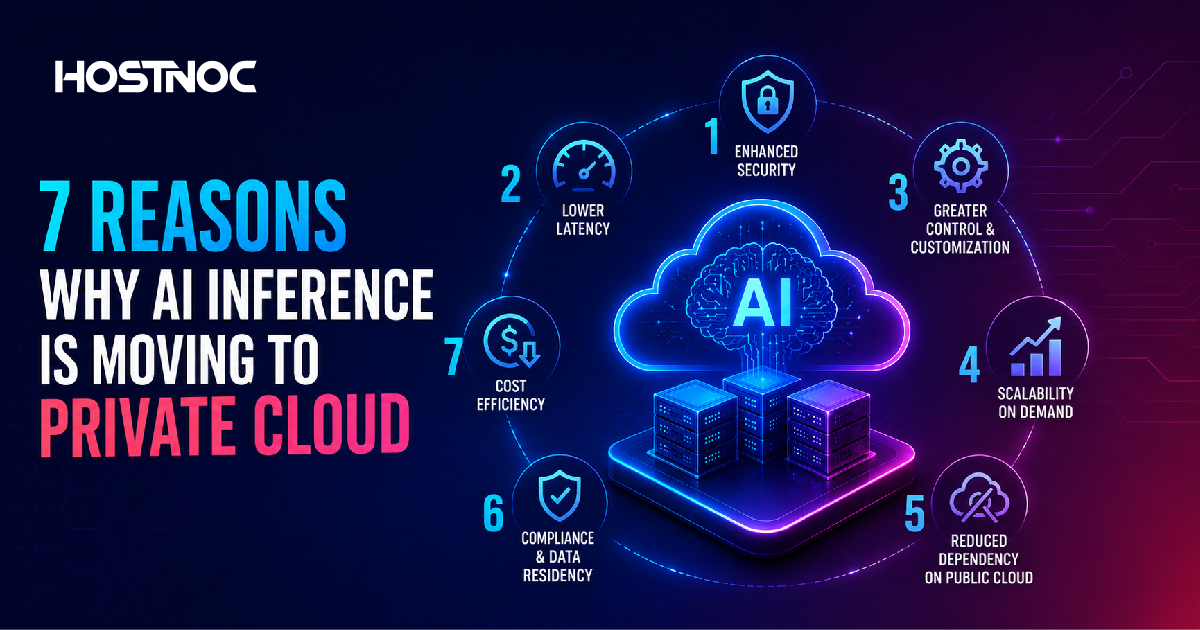
7 Reasons Why AI Inference Is Moving to Private Cloud
Enterprises are moving beyond AI experimentation and into large-scale production deployments, a...
Cloud for Finance: Everything You Need To Know
Key Takeaways Cloud for finance refers to both cloud-based financial systems and...
Follow us on:


Get the Latest News & Deals
Sign up to receive the latest news, updates and special offers from HostNOC.
I'd like to receive: