Blogs
on
Why Is a Dedicated Server for E-Commerce a Smart Choice?
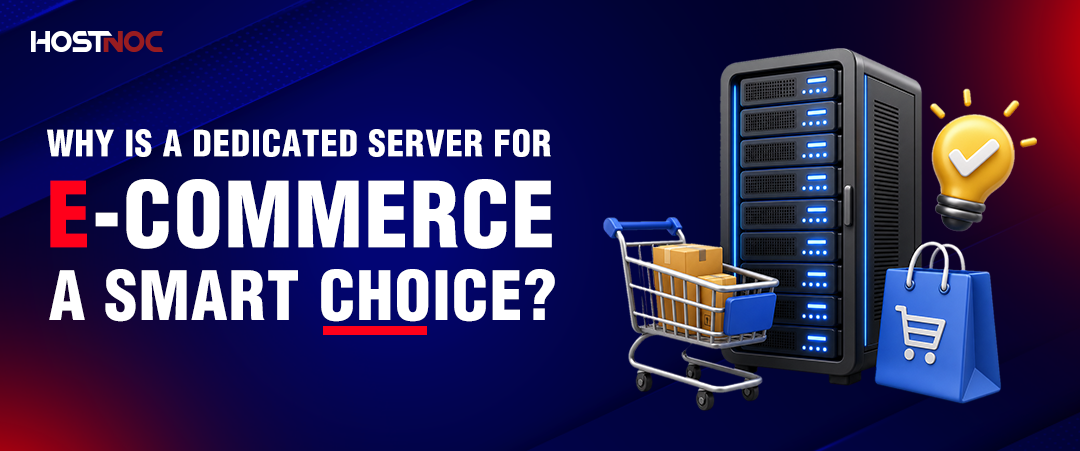
A dedicated server for e-commerce allows your online store to have full, exclusive access to the CPU, memory, hard drives, and bandwidth allocated to a single physical machine. There will be no shared resources. You won’t get any noisy neighbors either. The outcome? Increased loading speeds, up to 99.99% uptime, PCI DSS compliance, improved Google ranking, and everything your online store will need to turn traffic into sales.
A dedicated server for e-commerce allows your online store to have full, exclusive access to the CPU, memory, hard drives, and bandwidth allocated to a single physical machine. There will be no shared resources. You won’t get any noisy neighbors either. The outcome? Increased loading speeds, up to 99.99% uptime, PCI DSS compliance, improved Google ranking, and everything your online store will need to turn traffic into sales.
Key Takeaways
- Dedicated servers provide your store with exclusive hardware resources, overcoming limitations imposed by shared hosting environments.
- 100 milliseconds of extra latency decreases conversions by 7%. Dedicated servers deliver consistent TTFB below 100ms.
- 99.99% uptime means less than an hour of downtime per year, essential during Black Friday and Cyber Monday.
- PCI DSS compliance is only achievable through dedicated hosting for online payments.
- You should consider migration from shared hosting when monthly revenues exceed $5,000, the product catalog surpasses 1,000 SKUs, and monthly visitors reach 20,000.
- Starting prices for entry-level dedicated hosting begin at just $80/month.
What Is a Dedicated Server?
Dedicated servers are single computers assigned to one client alone. Unlike virtual or shared hosting, where several clients share the computer’s resources, a dedicated server offers your online store complete and exclusive use of all computing resources available on the server, including its CPU core count, RAM capacity, NVMe SSD storage space, and bandwidth.
You will not be sharing computing resources with anyone else and can therefore enjoy unhindered performance without any form of interference.
For sites with lots of traffic and any online retail store worth its salt, a dedicated server is undoubtedly the best hosting platform out there. This also makes it a useful reference point in any dedicated server guide for businesses evaluating hosting options.
Why Shared Hosting Fails E-Commerce Websites
The Resource Contention Problem
The problem with shared hosting is that if multiple websites reside on the same computer, they will have identical CPU usage time, memory usage, speed of accessing their disk drives, and bandwidth consumption rates. If one website suffers from excess traffic, the others are affected negatively.
This is not a theoretical risk. Hosting providers call it the “noisy neighbor” effect, and it directly translates into:
- Slow product page rendering
- Timed-out checkout sessions
- Payment gateway failures
- Abandoned carts and lost revenue
Traffic Spikes Expose the Weakness
Black Friday, Cyber Monday, Christmas, and other holiday shopping periods create huge traffic spikes. Shared hosting services fail to handle such pressure regularly.
Response time of 100 milliseconds leads to a drop in conversion rate by 7%. At times, shared hosting can be slower than 2,000-5,000 milliseconds during peak seasons. This will mean a loss of 40-70% in conversions.
Shared Hosting Creates Compounding Security Risks
The security for shared hosting is based on the server and not the site. In case of a breach of security at one site, the malware will spread to other sites on the same server.
There are 3 types of security threats in shared hosting:
- Cross-contamination: The malware from one site spreads to other sites’ file systems.
- Shared SSL threats: A compromised shared SSL impacts all sites hosted.
- Blacklisting: If you use a shared IP address, sending spam from one site will result in blacklisting of your IP address.

Dedicated Server vs. Shared Hosting: Direct Comparison
|
Feature |
Shared Hosting |
Dedicated Server |
| Resource Allocation | Shared among 100s of sites | 100% exclusive to your site |
| Uptime During Traffic Spikes | Unreliable | Consistent (99.99% SLA) |
| Page Load Speed | Variable | Consistently fast |
| Security Isolation | None | Full isolation |
| IP Address | Shared | Unique |
| Scalability | Limited | High |
| PCI DSS Compliance | Not achievable | Achievable |
| Cost | $3–$15/month | $80–$500+/month |
| Best For | Blogs, portfolios | E-commerce, enterprise sites |
6 Core Reasons E-Commerce Stores Run on Dedicated Servers
1. Exclusive Resource Allocation Delivers Consistent Performance
A dedicated server for e-commerce delivers 100% of its CPU, RAM, storage, and bandwidth to your store regardless of traffic volumes elsewhere on the internet.
With proper configuration:
- Product pages achieve sub-second load times, even during peak traffic events.
- Checkout flows complete without timeout errors.
- Search and filtering queries return results instantly.
- Large product catalogs with dynamic content and multimedia load at peak efficiency.
Even a one-second delay in page loading reduces conversions by 7%. On a dedicated server, that delay is engineered out of the equation.
2. 99.99% Uptime Protects Revenue
Uptime is also a measure of income, and not technicality. Take a store earning $50,000 monthly:
- 99.9% uptime would mean 8.7 hours of server downtime within a year.
- With average hourly earnings of $69, this results in losing up to $600 worth of money each year without considering the loss of credibility from customers.
In dedicated servers, there would be less than an hour of downtime due to 99.99% uptime. This is guaranteed by HostNOC under an official Service Level Agreement for uninterrupted service. In other words, high-income-generating stores get more from this arrangement and save thousands.
3. Isolated Security Architecture for Payment Processing
A dedicated server creates a completely isolated hosting environment. Threats targeting other websites have no pathway into your infrastructure unless they directly target your IP.
4 security advantages of a dedicated server for e-commerce:
- Firewall customization configures rules specific to your traffic patterns, blocking known threat vectors at the network edge.
- DDoS mitigation absorbs volumetric attacks at the hardware level without affecting site availability.
- PCI DSS compliance is significantly easier to achieve on a dedicated environment; a shared hosting multi-tenant architecture cannot meet PCI DSS certification requirements.
- Rapid incident isolation contains any compromise to your server alone, without affecting any other business infrastructure.
For e-commerce websites handling credit card details and personal customer data, this isolation is the foundation of maintaining customer trust and complying with GDPR and PCI DSS data protection regulations.
4. Full Customization and Control
When utilizing a dedicated server, full customization and control over server configuration, installation of required software, and security settings become possible. Such possibilities allow online stores to:
- Customize and set up any e-commerce software platform, such as Magento, WooCommerce, OpenCart, PrestaShop, and even a combination thereof.
- Configure unique integrations such as CRM systems, inventory management platforms, and payment gateways.
- Choose and tune the operating system: Linux distributions like Ubuntu 22.04 LTS or AlmaLinux 9 are optimal for lower memory overhead, superior process isolation, and LAMP/LEMP stack compatibility.
- Implement caching layers (Redis, Varnish), CDN integration, and load balancer setups.
This level of customization is especially important for businesses running specialized e-commerce applications or complex B2B workflows.
5. The Dedicated IP Helps SEO and Email Delivery
For shared hosting, multiple sites on the same account share the same IP address. In case any of the sites are involved in spamming activities, black hat SEO, or anything malicious, then all the domains using that IP address would get listed on a blacklist, and hence would affect the deliverability and SEO.
However, when you opt for a dedicated server plan, your domain will receive its own unique IP address. This will be advantageous for:
- Transactional email deliverability (order confirmations, shipping updates, password resets).
- Domain authority and search ranking signals.
- SSL certificate trust chains.
6. Quick Server Responses Will Help Your Site Rank Better on Google
It is now established that LCP, INP, and CLS from Google’s Core Web Vitals are ranking factors. All three factors are affected by server response time.
According to Google recommendations, server response time (Time to First Byte or TTFB) should be less than 200 ms. However, in shared hosting environments, the time is usually above 600–1,200 ms. On properly configured dedicated servers, the time is always less than 100 ms.
The downstream effect: stores on dedicated servers rank higher organically, generate more free search traffic, and reduce dependence on paid acquisition, compounding ROI over time.

Dedicated Server for WooCommerce and Magento
Both WooCommerce and Magento are resource-heavy platforms that outgrow shared hosting quickly. This section covers the hardware baseline each platform needs on a dedicated server. For deeper platform-specific configuration guidance, the dedicated posts on Magento optimized dedicated servers and VPS hosting for WooCommerce stores cover the full technical setup.
WooCommerce on a Dedicated Server
WooCommerce is a WordPress-based e-commerce solution and is by far the most popular shopping cart software with over 6.6 million live installations worldwide. It is one of the heaviest PHP applications.
WooCommerce websites with over 500 unique products, active coupons, and integrated payment systems exhaust the capabilities of shared hosting solutions easily.
To run WooCommerce reliably on a dedicated server, you will need at least 8GB RAM, NVMe SSD storage, and a relatively modern Intel Xeon or AMD EPYC processor.
Magento on a Dedicated Server
Magento (also referred to as Adobe Commerce) is the enterprise-level platform for e-commerce stores with big catalogs and complicated business-to-business processes. The requirements specified by Magento itself state that dedicated server hosting is highly recommended for running Magento.
Magento 2 open-source minimum requirements:
- 4 GB minimum RAM (recommended: 8+ GB RAM)
- PHP 8.1 or PHP 8.2
- MySQL 8.0 or MariaDB 10.6
- Catalog search engine like Elasticsearch or OpenSearch
All the above requirements will be satisfied in the best way possible only by a dedicated server.
Criteria for Selecting a Suitable Dedicated Server for E-commerce
The ideal dedicated server is the one that perfectly fits your existing workload, the possibility of growth, and technical expertise. There are 5 major criteria that should always be considered while selecting a dedicated server, or else it will prove to be expensive and wasteful.
1. Hardware Requirements of the Server
Take into account the hardware specifications of your website. For a large-scale store that attracts many users, provides numerous products, and operates with media resources, extra CPU cores, RAM, and disk capacity are required.
The availability of NVMe SSD ensures rapid access to the database of your products and customer activity within minutes, instead of SATA SSD.
| Store Size | CPU | RAM | Storage | Bandwidth |
| Small (under 500 SKUs) | 4-core Intel Xeon | 16GB | 250GB NVMe SSD | 500 Mbps |
| Mid-size (500–5,000 SKUs) | 8-core Intel Xeon / AMD EPYC | 32GB | 500GB NVMe SSD | 1 Gbps unmetered |
| Enterprise (5,000+ SKUs) | 16+ core AMD EPYC | 64GB+ | 1TB+ NVMe SSD | 1 Gbps unmetered |
2. Differences Between Managed Hosting and Unmanaged Hosting
In managed dedicated hosting, the hosting company takes care of server management, software security updates, and performance optimization. The server also receives operating system updates and is constantly monitored.
Unmanaged dedicated hosting gives full root control with zero provider intervention beyond hardware. It requires a skilled Linux systems administrator on your team.
| Option | Best For | Trade-off |
| Managed | Stores without in-house server expertise | Higher monthly cost, zero technical overhead |
| Unmanaged | Dev teams with strong Linux/server admin skills | Lower cost, full responsibility for uptime |
For most e-commerce businesses, fully managed dedicated hosting is the right choice. A single hour of downtime during a sales event costs far more than the monthly managed service premium. For a deeper managed vs unmanaged server hosting comparison, businesses should evaluate their technical resources, budget, and operational requirements.
3. Operating System
Linux is the correct operating system for a dedicated server for e-commerce. Specifically, Ubuntu 22.04 LTS and AlmaLinux 9 are the 2 best options.
Both deliver:
- Lower memory overhead than Windows Server, freeing RAM for application processes.
- Native LAMP (Linux, Apache, MySQL, PHP) and LEMP (Linux, Nginx, MySQL, PHP) stack compatibility.
- Improved process separation and reduced vulnerability surface area.
- Zero cost for seat-based license purchase.
A Windows Server-hosted solution would provide similar functionality, but at increased costs due to licensing fees, increased memory consumption, and lower optimization for WooCommerce, Magento, and most other open-source stacks.
4. Security Features
Assess dedicated servers based on their provision of these 5 essential security features:
- Firewall configuration management with customization capabilities.
- Malware detection and intrusion prevention with alerting features.
- Provisioning of free SSL certificates with automatic renewal.
- Free SSL certificate provisioning with auto-renewal.
- Assignment of a dedicated IP address exclusively for your website.
5. Support and Service Level Agreements
An SLA is only valuable if the provider actually meets it. Look for 4 specific commitments:
- 24/7 managed support staffed by engineers with e-commerce platform expertise, not generic helpdesk agents.
- A formal uptime SLA of 99.99% with financial compensation for breaches.
- Documented incident response times. HostNOC guarantees a 30-minute response to critical server issues.
- Redundant network connectivity with BGP failover to eliminate single points of network failure.

Dedicated Server vs. VPS for E-Commerce
The dedicated server provides your business with its own physical server, while a VPS allows you to share a portion of the physical server. This distinction becomes more pronounced when there is a traffic spike, transaction processing, and auditing.
The VPS uses the hypervisor in order to create multiple instances of the physical server, where different CPUs, RAMs, and storage space are assigned to each instance. With an increase in traffic, the hypervisor causes overhead and affects other neighboring instances as well.
In contrast, the dedicated server does not need this extra layer.
| Factor | Dedicated Server | VPS Hosting |
| Hardware Access | Full physical machine, bare metal | Virtualized slice of shared hardware |
| Performance Under Load | Maximum, no hypervisor overhead | Strong, but virtualization adds latency |
| Resource Guarantee | 100% exclusive | Allocated, but shared at the hardware level |
| Customization | Complete OS and hardware control | Limited by hypervisor and provider rules |
| PCI DSS Compliance | Fully achievable | Harder to certify, possible with managed VPS |
| Cost | $80–$500+/month | $12–$100/month |
| Best For | High-traffic stores, 20,000+ monthly visitors, enterprise workloads | Growing stores under 20,000 monthly visitors, scaling toward dedicated |
The practical decision: If your store processes more than 500 transactions per day, runs paid traffic campaigns, or is preparing for PCI DSS certification, a dedicated server is the correct choice. If you are scaling toward those thresholds, a managed VPS is the right intermediate step. For businesses still evaluating infrastructure options, understanding dedicated vs. VPS hosting can help determine the best fit for performance, scalability, and long-term growth.
When to Migrate from Shared Hosting to a Dedicated Server
Switch to a dedicated server for an e-commerce store in any of the following cases:
- The monthly revenue of the online store is higher than $5,000; risks of downtime have become more important than the difference between hosting costs.
- Product catalog exceeds 1,000 SKUs.
- Average monthly unique visitors exceed 20,000.
- You are doing paid marketing, and you can’t tolerate losing orders.
- You have plans for a promotional event (sale, new product release, seasonality).
- Your current hosting provider warns about frequent CPU limits being hit.
- Compliance with PCI-DSS requirements becomes necessary.
Below this line? You should consider a managed VPS, which represents a relatively cheap alternative that is both dedicated and secure yet doesn’t require the investment typical for a dedicated server. For businesses planning future upgrades, it may also help to follow a migration from shared hosting to a dedicated server guide.
What Does a Dedicated Server for E-Commerce Cost?
Plans for a dedicated server for e-commerce range from $80 to $500+ per month. The price reflects hardware generation, RAM capacity, storage type, managed service level, and included security features.
Here is how pricing breaks down across 3 tiers:
| Tier | Specs | Monthly Cost | Best For |
| Entry-level | 4-core CPU, 16GB RAM, 250GB NVMe SSD | $80–$120 | Mid-sized WooCommerce stores |
| Mid-range | 8-core CPU, 32GB RAM, 500GB NVMe SSD, managed | $150–$250 | Growing stores, 20,000+ monthly visitors |
| Enterprise | 16+ core AMD EPYC, 64GB RAM, 1TB NVMe SSD, fully managed | $300–$500+ | High-volume Magento, B2B, enterprise |
The 5 cost variables that move a plan up or down in price:
- CPU core count and processor generation (AMD EPYC costs more than older Intel Xeon).
- RAM capacity 32GB costs roughly 40% more than 16GB at the same spec level.
- Storage type: NVMe SSD carries a premium over SATA SSD but delivers 3–5x faster disk I/O.
- Managed service level: Fully managed adds $30–$80/month but covers all server administration.
- Included DDoS protection and dedicated IP allocation.
The cost comparison that matters: A $120/month dedicated server protecting a $50,000/month store represents 0.24% of revenue. One hour of downtime during a peak sales event costs more than 3 months of hosting. This illustrates why understanding dedicated server cost is essential when evaluating long-term business value and infrastructure investment.
Conclusion:
For informational sites, it is acceptable to begin with shared hosting; however, for e-commerce, it is a structural disadvantage.
6 key reasons why e-commerce uses dedicated servers:
- Exclusive resources prevent any slowdowns in the case of sudden increases in traffic volume.
- Guaranteed uptime at 99.99% ensures income during shopping holidays.
- Isolated security architecture complies with PCI DSS guidelines and avoids cross-site infection.
- Full customization and management allow you to optimize your platform and integrate various features.
- Dedicated IP protects from SEO issues and email blacklisting.
- Quick response times help get better results in terms of Core Web Vitals and organic search positions.
In spite of the additional costs associated with dedicated server usage compared to other types of web hosting, it is a wise solution for an e-commerce website because of its numerous advantages.
Plug your brand into raw server muscle. No fluff, just dedicated firepower.
Cores
RAM
Storage
Location
Monthly Price
Link
Intel Xeon E3-1240 v6 3.7GHz 4c/8t
64 GB DDR4
Main Storage: 2 x 500 GB (SSD SATA)
Amsterdam, Netherlands
$79.95 /month
Buy Now
Dual Intel Xeon E5-2697 2.70 GHZ v2 (24 Cores / 48 Threads)
256 GB DDR3
Main Storage: 2 x 480 GB SSD
Bandwidth: Gigabit Port - 20 TB
$259.95 /month
Buy Now
Frequently Asked Questions About Dedicated Server for E-Commerce

Is a dedicated server necessary for a small e-commerce store?
No, it is unnecessary. For instance, when your monthly earnings exceed $5,000, when you have more than 500 products in stock, or when you begin purchasing visitors, you will need a dedicated server.
Can a dedicated server handle Black Friday traffic spikes?
Yes, my dedicated server will handle the Black Friday traffic because it provides consistent compute capacity without sharing it with anyone. Peak handling is achieved through caching engines like Redis and Varnish, while the content delivery network and load balancer ensure an even distribution of requests.
Does my dedicated server improve my SEO ranking for my e-commerce business?
Yes, three ways my dedicated server improves my SEO ranking include lower TTFB for higher CWV scores, reduced downtime to avoid crawl budget loss, and improved security with a unique IP address.
How does server location affect e-commerce performance?
Every 1,000km of additional network distance adds approximately 5–10ms of latency. A store targeting US customers performs best with servers in US-based data centers. HostNOC operates data centers in Seattle, Chicago, Miami, Dallas, New York, and Los Angeles.
Is a dedicated server more secure than shared hosting for processing payments?
Yes. Dedicated servers provide full environment isolation, customizable firewall rules, and a clear path to PCI DSS compliance, something shared hosting’s multi-tenant architecture fundamentally cannot achieve.
How much time will be required to configure a dedicated server for my online store?
Within 24-48 hours, HostNOC installs dedicated servers with no charge for migrating your existing websites from another host.
How does a managed dedicated server differ from an unmanaged one?
In the case of managed hosting, all the maintenance and management responsibilities fall upon the shoulders of the hosting service provider. In the case of unmanaged hosting, you will be responsible for managing the server yourself.
What is the best operating system for an e-commerce dedicated server?
Linux specifically Ubuntu 22.04 LTS or AlmaLinux 9. Both deliver lower memory overhead, a smaller attack surface, and native LAMP/LEMP stack compatibility compared to Windows Server.

Muhammad Osama
Muhammad Osama a qualified professional with ground-breaking experience in developing SEO campaigns, analytics, and monitoring the ranking in Google search pages. A clear communicator with an experience of digital marketing and improving brand search ranks.
Featured Post
Dedicated Server for Agencies: A Complete Guide
Agencies today manage multiple client websites, applications, and campaigns simultaneously. Shared hosting...

Sarmad Hasan
July 13, 2026
Does Borderlands 3 Have Dedicated Servers?
No. Borderlands 3 does not use dedicated servers. Multi player gaming sessions...

saad ullah
July 8, 2026
Data Center Market Share 2026: Hyperscalers vs. Colocation vs. Enterprise
The global data center industry is undergoing one of the most significant...
Sarmad Hasan
July 1, 2026