Blogs
PCI-DSS Compliance for Dedicated Servers: A Complete Guide
June 29, 2026
Managed vs. Unmanaged VPS: A Total Cost of Ownership (TCO) Breakdown
July 3, 2026
on
Data Center Market Share 2026: Hyperscalers vs. Colocation vs. Enterprise
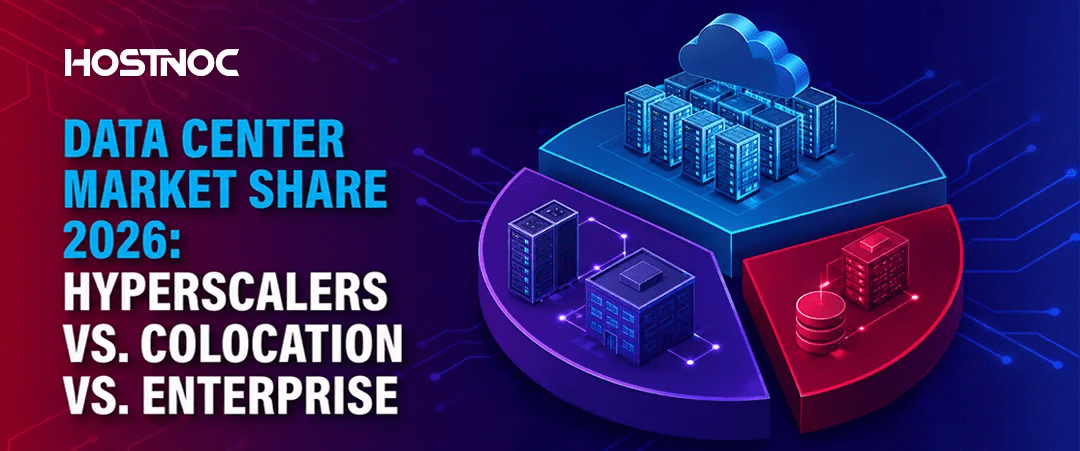
The global data center industry is undergoing one of the most significant structural shifts in its history. Once dominated by enterprise-owned, on-premise infrastructure, the market is now increasingly controlled by hyperscale cloud providers. This transformation is being driven by explosive demand for cloud computing, artificial intelligence (AI), and data-intensive workloads.
According to a report, hyperscalers are not just leading the market; they are reshaping its economics, scale, and future trajectory. By 2031, they are expected to control roughly two-thirds of global data center capacity, signaling a decisive shift in how digital infrastructure is built and consumed.
The global data center industry is undergoing one of the most significant structural shifts in its history. Once dominated by enterprise-owned, on-premise infrastructure, the market is now increasingly controlled by hyperscale cloud providers. This transformation is being driven by explosive demand for cloud computing, artificial intelligence (AI), and data-intensive workloads.
According to a report, hyperscalers are not just leading the market; they are reshaping its economics, scale, and future trajectory. By 2031, they are expected to control roughly two-thirds of global data center capacity, signaling a decisive shift in how digital infrastructure is built and consumed.
Key Takeaways
- Hyperscalers are becoming the dominant force in the data center market, with their share projected to grow from 22% in 2018 to 67% by 2031, while enterprise-owned infrastructure continues to decline.
- AI and cloud computing are the primary growth drivers, fueling massive investments in hyperscale facilities, GPU clusters, and high-density computing environments.
- Hyperscale capacity is expected to more than triple within the next five years, supported by the development of hundreds of new data centers worldwide.
- Colocation providers remain essential despite losing market share, as demand for edge computing, hybrid IT environments, and cloud spillover continues to drive steady capacity growth.
- Enterprise data centers are evolving rather than disappearing, with AI, data sovereignty, and compliance requirements encouraging renewed investment in on-premise and hybrid infrastructure.
- The future of digital infrastructure will be hybrid and interconnected, combining hyperscale efficiency, colocation flexibility, and enterprise control to support diverse workload requirements.
Data Center Market Share 2026
1. Market Share Evolution: From Enterprise Dominance to Hyperscale Control
2018: Enterprise-Led Era
- Enterprise (on-premise): 56%
- Colocation: 22%
- Hyperscale: 22%
Historically, enterprises built and managed their own data centers to maintain control over infrastructure, security, and compliance.
2025: Hyperscale Takes the Lead
- Enterprise: 32%
- Colocation: 20%
- Hyperscale: 48%
This marks the tipping point where hyperscalers overtook enterprise infrastructure as the dominant force.
2031 (Projected): Hyperscale Dominance
- Enterprise: 19%
- Colocation: 14%
- Hyperscale: 67%
By 2031, hyperscalers are expected to command the majority of global capacity, fundamentally redefining the data center landscape.
2. Hyperscalers: The Driving Force Behind Market Expansion
Hyperscalers such as major cloud and tech companies are scaling infrastructure at unprecedented rates.
Key Growth Drivers
- AI and GenAI workloads require massive compute power
- Cloud adoption across enterprises and SMBs
- Economies of scale lowering per-unit compute cost
- Rapid expansion of pipelines (hundreds of new facilities planned)
Industry data indicates:
- Hyperscale capacity is expected to grow more than threefold in the next five years
- The number of hyperscale facilities is rapidly expanding, with ~800 new data centers in development pipelines
Additionally, hyperscale infrastructure spending is accelerating due to AI:
- Massive investments in GPU clusters and AI infrastructure
- Continued reliance on advanced chips and high-density computing
This positions hyperscalers as the primary backbone of global digital infrastructure.
3. Colocation Providers: Growth Without Share Dominance
Colocation providers occupy a middle ground—offering shared infrastructure to enterprises without requiring full ownership.
Key Characteristics
- Flexible leasing models (retail & wholesale colocation)
- Neutral connectivity hubs
- Strategic locations for low-latency and edge computing
Market Outlook
- Market share declines slightly (22% → 14% by 2031)
- But absolute capacity continues to grow steadily
- Growth driven by:
- Cloud spillover demand
- Edge computing expansion
- Hybrid IT strategies
The global colocation market is projected to grow strongly, reaching well over $160B by 2030, reflecting sustained demand despite declining share. Colocation is not losing relevance—it is becoming complementary infrastructure to hyperscale ecosystems.
4. Enterprise Data Centers: Decline, Stabilization and AI Revival
Enterprise-owned data centers have seen the sharpest decline in relative market share.
Why Enterprises Are Declining
- High capital expenditure (CapEx)
- Complexity of managing modern infrastructure
- Shift toward cloud-first strategies
But Not a Complete Decline
Interestingly, enterprise capacity is:
- Not collapsing, but rather stabilizing
- Experiencing renewed growth due to AI workloads
AI is pushing enterprises to:
- Build on-premise GPU clusters
- Maintain data sovereignty and compliance
- Deploy hybrid cloud architectures
Recent insights show that enterprises are beginning to reinvest in on-premise AI infrastructure, especially for sensitive workloads and regulatory needs.
This signals a hybrid future, not a full cloud takeover.
5. The Role of AI: The Ultimate Market Accelerator
AI is the single most important factor reshaping the data center market.
Impact Across All Segments
| Segment | AI Impact |
| Hyperscalers | Massive expansion of GPU clusters and AI cloud services |
| Colocation | Demand for high-density racks and AI-ready facilities |
| Enterprise | Revival of on-prem infrastructure for sensitive AI workloads |
Hyperscale data center markets alone are expected to grow at over 24% CAGR, fueled primarily by AI demand.
6. Ownership Models: Leased vs. Owned Hyperscale Capacity
A notable internal shift within hyperscale infrastructure:
- Owned capacity is becoming dominant
- Moving away from reliance on colocation leasing
By 2031:
- Owned hyperscale: 40%
- Leased hyperscale: 27%
This indicates hyperscalers are:
- Seeking greater control
- Optimizing for efficiency and scale
- Reducing dependence on third-party facilities
7. Strategic Implications for the Industry
For Cloud Providers
- Continued aggressive expansion
- Vertical integration (owning infrastructure end-to-end)
For Colocation Companies
- Pivot toward:
- AI-ready infrastructure
- Edge locations
- Interconnection ecosystems
For Enterprises
- Adoption of hybrid strategies
- Selective on-premise investments for AI and compliance
8. The Future: A Hybrid, Hyperscale-Centric Ecosystem
Despite hyperscaler dominance, the future is not a single-model monopoly.
Instead, the market is evolving into a three-tier ecosystem:
- Hyperscale Core – bulk of compute and storage
- Colocation Edge – distributed, flexible capacity
- Enterprise Hybrid – specialized, secure workloads
Each plays a distinct role:
- Hyperscalers → scale and efficiency
- Colocation → flexibility and proximity
- Enterprise → control and compliance
Conclusion
The data center market share is no longer enterprise-led; it is hyperscale-driven. With projections showing hyperscalers controlling ~67% of global capacity by 2031, the shift is both decisive and irreversible.
However, the narrative is not about replacement but rebalancing:
- Enterprises are evolving, not disappearing
- Colocation is adapting, not declining
- Hyperscalers are expanding, not operating in isolation
Ultimately, the future of data infrastructure lies in a hybrid, interconnected ecosystem, powered by AI and dominated by hyperscale scale—but supported by colocation flexibility and enterprise specialization.

Featured Post
Dedicated Server for Agencies: A Complete Guide
Key Takeaways A dedicated server gives agencies full control, predictable performance, and stronger security compared to shared or VPS hosting. It’s ideal for handling high-traffic client […]

Sarmad Hasan
July 13, 2026
Does Borderlands 3 Have Dedicated Servers?
No. Borderlands 3 does not use dedicated servers. Multi player gaming sessions depend on the host player while match making assists players to find games they […]

saad ullah
July 8, 2026
PCI-DSS Compliance for Dedicated Servers: A Complete Guide
Handling payment card data comes with serious security responsibilities. Businesses operating on dedicated servers often assume they are inherently secure but without proper controls, they can […]
Sarmad Hasan
June 29, 2026