Blogs
on
Managed vs. Unmanaged VPS: A Total Cost of Ownership (TCO) Breakdown
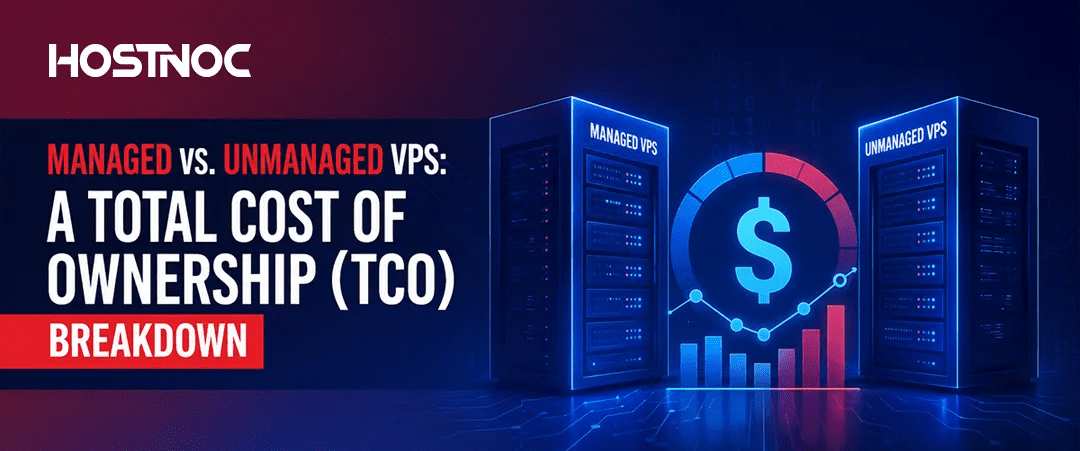
Choosing between managed and unmanaged VPS hosting is not just a technical decision; it’s a financial one. Many businesses underestimate the true cost of running a virtual server, focusing only on the monthly fee while ignoring operational overhead.
That oversight can lead to spiraling expenses: developer hours lost to server maintenance, unexpected downtime, security breaches and costly recovery efforts. What looks cheap upfront can quietly become the most expensive option over time.
To make the right decision in 2026, you need a Total Cost of Ownership (TCO) perspective, factoring in not just hosting fees but hidden costs like admin time, security management and risk exposure. Let’s break it down clearly.
Choosing between managed and unmanaged VPS hosting is not just a technical decision; it’s a financial one. Many businesses underestimate the true cost of running a virtual server, focusing only on the monthly fee while ignoring operational overhead.
That oversight can lead to spiraling expenses: developer hours lost to server maintenance, unexpected downtime, security breaches and costly recovery efforts. What looks cheap upfront can quietly become the most expensive option over time.
To make the right decision in 2026, you need a Total Cost of Ownership (TCO) perspective, factoring in not just hosting fees but hidden costs like admin time, security management and risk exposure. Let’s break it down clearly.
Key Takeaways
- Monthly VPS pricing does not reflect the true cost—you must consider Total Cost of Ownership (TCO), including labor, security, downtime and operational expenses.
- Unmanaged VPS plans are cheaper upfront ($5–$50/month), but server administration, maintenance and troubleshooting can significantly increase overall costs.
- Managed VPS reduces operational burden by handling updates, monitoring, backups and security, allowing teams to focus on business growth rather than server management.
- Security and downtime are major hidden expenses in unmanaged environments, where misconfigurations, vulnerabilities or outages can lead to costly disruptions and recovery efforts.
- Managed VPS offers lower risk and easier scalability, with built-in support, monitoring and streamlined resource upgrades that help maintain performance as workloads grow.
- For most businesses in 2026, managed VPS delivers a lower long-term TCO, while unmanaged VPS is best suited for organizations with experienced DevOps or system administration expertise.
What is VPS Hosting?
A Virtual Private Server (VPS) splits a physical server into isolated environments using virtualization technologies like KVM or VMware. It gives you dedicated resources at a fraction of the cost of a full dedicated server.
There are two main types:
- Managed VPS – Provider handles maintenance, security, updates.
- Unmanaged VPS – You control everything (and are responsible for everything).

Core Cost Components (TCO Framework)
To compare accurately, we will evaluate:
- Direct Costs (monthly fees)
- Operational Costs (time, staff, tools)
- Risk Costs (downtime, breaches)
- Scaling Costs
- Opportunity Costs
1. Managed vs. Unmanaged VPS: Direct Costs
Managed VPS
- Typically: $20–$150/month
- Providers like DigitalOcean, Linode and Amazon Web Services offer managed tiers.
Includes:
- OS updates
- Monitoring
- Support
- Backups
Unmanaged VPS
- Typically: $5–$50/month
- Same providers offer cheaper self-managed plans.
Verdict:
Unmanaged is clearly cheaper on paper.
2. Managed vs. Unmanaged VPS: Admin and Labor Costs
This is where the real difference emerges.
Managed VPS
- Minimal admin work
- Estimated time: 2–5 hours/month
- Cost (developer/sysadmin time): ~$50–$300/month equivalent
Unmanaged VPS
You handle:
- Server setup
- Security hardening
- Updates
- Troubleshooting
Estimated:
- 15–40 hours/month
- At $20–$50/hour → $300–$2,000/month
Even basic tasks like configuring NGINX or maintaining Docker consume time. Unmanaged VPS often becomes 3–10× more expensive when labor is included.
3. Managed vs. Unmanaged VPS: Security Costs and Risks
Managed VPS
Includes:
- Firewall setup
- Malware scanning
- Patch management
Tools often integrated:
- Fail2Ban
- ClamAV
Unmanaged VPS
You must:
- Configure firewalls
- Monitor logs
- Patch vulnerabilities
- Respond to attacks
Hidden Costs:
- Security tools subscriptions
- Incident response time
- Potential breach cost
A single breach involving ransomware like WannaCry can cost thousands in downtime and recovery.
Verdict:
Security is the most underestimated total cost of ownership factor.
4. Managed vs. Unmanaged VPS: Downtime and Reliability Costs
Managed VPS
- SLA-backed uptime
- Automatic failover
- Monitoring teams
Unmanaged VPS
- You detect and fix outages manually
Downtime cost example:
- Small business: $100–$1,000/hour
- SaaS/app: $1,000–$10,000+/hour
Monitoring tools like UptimeRobot or Datadog add extra cost.
5. Managed vs. Unmanaged VPS: Scaling and Performance Costs
Managed VPS
- Easy scaling via the dashboard
- Optimized configurations
Unmanaged VPS
- Manual scaling
- Risk of misconfiguration
Poor optimization (e.g., bad caching or database tuning in MySQL) can lead to:
- Higher infrastructure costs
- Slower performance → lost revenue
6. Managed vs. Unmanaged VPS: Opportunity Cost
This is often ignored but crucial.
Managed VPS
Let developers focus on:
- Product development
- Growth
- Customer experience
Unmanaged VPS
Engineers spend time on:
- Server maintenance
- Debugging issues
- Security patching
Example:
Instead of building features, your team is fixing a broken Linux configuration at 2 AM.
Managed vs. Unmanaged VPS: Total Cost of Ownership
| Cost Category | Managed VPS | Unmanaged VPS |
| Monthly Fee | Higher | Lower |
| Admin Time | Low | Very High |
| Security Overhead | Included | DIY (costly) |
| Downtime Risk | Low | Medium–High |
| Scaling Effort | Easy | Complex |
| True Monthly TCO | $50–$300 | $300–$2,500+ |
When Managed VPS Makes Sense?
Choose managed if:
- You lack a dedicated DevOps team
- You run business-critical applications
- Security and uptime matter
- You value predictable costs
Ideal for:
- Startups
- SaaS companies
- E-commerce stores
When Unmanaged VPS Makes Sense?
Choose unmanaged if:
- You have strong sysadmin/DevOps expertise
- You need full control over the stack
- You are optimizing for cost and know what you are doing
Ideal for:
- Experienced developers
- Infrastructure engineers
- Custom environments
Conclusion
The biggest mistake in 2026 is evaluating VPS options based only on the monthly price.
The real equation is:
Total Cost of Ownership = Hosting Cost + Time + Risk + Tools + Missed Opportunities
In most real-world scenarios, managed VPS is cheaper in the long run, despite higher upfront pricing.

Featured Post
Bare Metal vs Cloud Computing: A Comprehensive Comparison
Key Takeaways Bare metal servers deliver maximum performance, full hardware control, and...

Sarmad Hasan
July 8, 2026

Windows VPS Hosting vs Linux VPS Hosting: A Detailed Comparison
Key Takeaways VPS hosting provides dedicated resources and full server control, offering...
Sarmad Hasan
June 26, 2026

URI vs URL: The Definitive Difference Explained Clearly
If you have ever worked with websites, APIs, web development or networking,...

saad ullah
June 18, 2026