Blogs
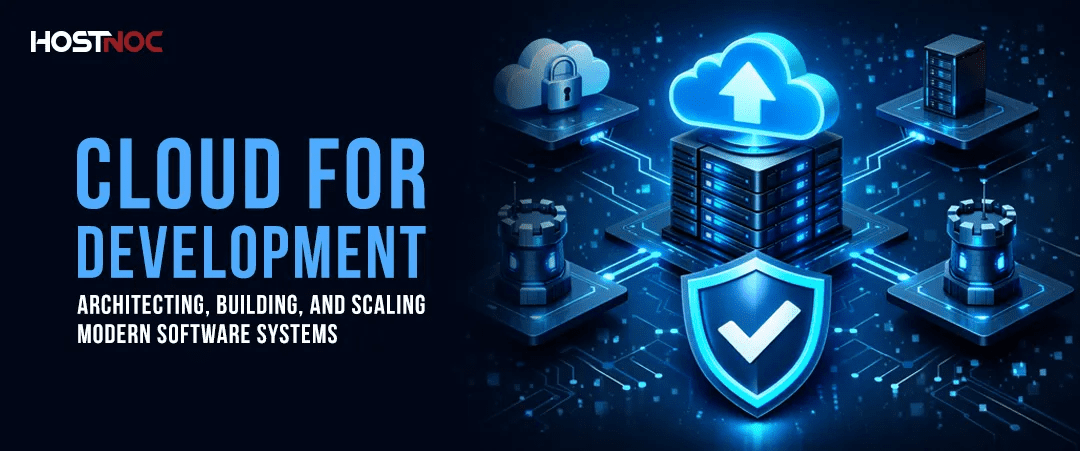
Cloud computing has evolved far beyond its original promise of “renting servers instead of owning them.” For modern software development, the cloud is no longer merely an infrastructure choice, it is the primary development substrate on which applications are designed, built, tested, deployed, and evolved.
Cloud-native development fundamentally changes how teams think about architecture, scalability, delivery velocity, fault tolerance, security, and cost. Services such as Amazon Web Services (AWS), Microsoft Azure, Google Cloud Platform (GCP), and newer developer-centric platforms like Vercel, Netlify, Supabase, and Fly.io have reshaped the entire software lifecycle.
This article explores cloud for development through a practical, technical lens—covering architecture models, development workflows, tooling, environments, security, observability, cost control, and real-world tradeoffs.
Cloud For Development: Everything You Need To Know
Here is all you need to know about cloud for development.
Core Cloud Service Models for Development
Infrastructure as a Service (IaaS)
IaaS provides foundational compute, networking, and storage primitives. Developers retain maximum control over the operating system and runtime environment.
Key examples:
- AWS EC2, Azure Virtual Machines, Google Compute Engine
- Block storage: Amazon EBS, Azure Managed Disks
- Networking: VPC, Subnets, Security Groups, Load Balancers
Here are some cloud for development use cases:
- Legacy application modernization
- Custom runtime requirements
- Stateful services requiring fine-grained tuning
Tradeoff: High flexibility comes with higher operational overhead, including OS patching, scaling logic, and availability management.
Platform as a Service (PaaS)
PaaS abstracts infrastructure concerns and focuses developer effort on application logic.
Examples:
- AWS Elastic Beanstalk
- Azure App Service
- Google App Engine
- Heroku
Development advantages:
- Faster time-to-market
- Simplified CI/CD integration
- Built-in scaling and health checks
Limitations:
- Opinionated runtimes
- Less control over underlying infrastructure
- Potential vendor lock-in
Function as a Service (FaaS) and Serverless Development
Serverless computing shifts execution to event-driven functions with no server management.
Prominent platforms:
- AWS Lambda
- Azure Functions
- Google Cloud Functions
- Cloudflare Workers
Development characteristics:
- Stateless execution
- Millisecond-scale billing
- Automatic horizontal scaling
Common use cases:
- APIs (via API Gateway)
- Data processing pipelines
- Webhooks and event handlers
- Background jobs
Challenges:
- Cold starts
- Distributed debugging
- Complex local development environments
- State management across invocations
Cloud-Native Application Architecture
Microservices Architecture
Cloud platforms enable microservices by providing:
- Service discovery
- Load balancing
- Independent scaling
- Managed networking
Common tooling:
- Docker for containerization
- Kubernetes (EKS, AKS, GKE) for orchestration
- Istio / Linkerd for service mesh
Microservices allow teams to:
- Deploy independently
- Use heterogeneous tech stacks
- Scale bottlenecks selectively
But they also introduce:
- Network latency
- Distributed tracing complexity
- Higher operational cognitive load
Container-Based Development
Containers are the de facto standard for cloud for development.
Core components:
- Dockerfiles define immutable build artifacts
- Container registries (Amazon ECR, Azure ACR, Google Artifact Registry)
- Kubernetes manifests or Helm charts define deployments
Development benefits:
- Environment parity between local, staging, and production
- Faster onboarding for developers
- Predictable dependency management
Modern trends:
- Dev Containers (VS Code)
- Tilt, Skaffold, and Garden for local Kubernetes workflows
Monoliths Are Not Dead (in the Cloud)
Cloud development does not mandate microservices. Well-structured modular monoliths deployed on cloud infrastructure can:
- Reduce latency
- Simplify debugging
- Lower operational costs
Many startups successfully run monoliths on:
- Single Kubernetes deployments
- Managed PaaS platforms
- Serverless containers (AWS Fargate, Google Cloud Run)
The cloud enables evolutionary architecture, not forced fragmentation.
Development Environments in the Cloud
Local Development vs Cloud-Based Development
Traditional model:
- Local IDE
- Local database
- Mocked services
Cloud-enhanced model:
- Remote development environments
- Shared staging resources
- Cloud-hosted dependencies
Emerging tools:
- GitHub Codespaces
- Gitpod
- JetBrains Space
- AWS Cloud9
Benefits:
- Zero local setup
- Consistent environments
- Secure access to cloud resources
Infrastructure as Code (IaC)
IaC is foundational for cloud for development.
Popular tools:
- Terraform
- AWS CloudFormation
- Azure Bicep
- Pulumi
IaC enables:
- Reproducible environments
- Version-controlled infrastructure
- Automated environment provisioning (dev, test, prod)
Advanced patterns:
- Multi-account AWS architectures
- Blue/green deployments
- Immutable infrastructure
CI/CD Pipelines in Cloud Development
Cloud-native CI/CD integrates deeply with development workflows.
Common platforms:
- GitHub Actions
- GitLab CI
- Bitbucket Pipelines
- Azure DevOps
Pipeline stages typically include:
- Static code analysis
- Unit and integration testing
- Container image builds
- Security scanning (Snyk, Trivy)
- Automated deployment
Advanced deployment strategies:
- Canary releases
- Feature flags (LaunchDarkly, Unleash)
- Progressive rollouts
Cloud providers often supply native deployment tools:
- AWS CodePipeline
- Google Cloud Build
- Azure Pipelines
Data and Storage in Cloud Development
Managed Databases
Developers increasingly rely on managed data services.
Relational:
- Amazon RDS, Aurora
- Azure SQL Database
- Cloud SQL
NoSQL:
- DynamoDB
- Cosmos DB
- Firestore
- MongoDB Atlas
Benefits:
- Automated backups
- High availability
- Built-in scaling
Tradeoff:
- Less control over tuning
- Pricing tied to usage patterns
Object Storage as a Development Primitive
Object storage is often used as:
- Static asset hosting
- Data lakes
- Backup and archival
Examples:
- Amazon S3
- Azure Blob Storage
- Google Cloud Storage
Many modern architectures treat object storage as:
- A message queue
- A data interchange format
- A trigger for serverless workflows
Security in Cloud Development
Identity and Access Management (IAM)
IAM is central to cloud security.
Key concepts:
- Least privilege access
- Role-based access control
- Temporary credentials
Services:
- AWS IAM
- Azure Active Directory
- Google Cloud IAM
Developers must understand:
- Policy documents
- Service roles
- Cross-account access
DevSecOps Integration
Security shifts left in cloud development.
Practices include:
- Secret management (AWS Secrets Manager, Vault)
- Dependency scanning
- Runtime security monitoring
- Infrastructure policy enforcement (OPA, Sentinel)
Security becomes part of the development pipeline, not an afterthought.
Observability and Debugging in the Cloud
Logging, Metrics, and Tracing
Cloud-native observability stacks include:
- CloudWatch, Azure Monitor, Google Cloud Operations
- Prometheus
- Grafana
- OpenTelemetry
- Jaeger
Developers must design for:
- Distributed tracing
- Correlation IDs
- Structured logging
Debugging in the cloud requires observability by design, not ad-hoc logs.
Cost Awareness and FinOps for Developers
Cloud development introduces real-time cost implications.
Key cost drivers:
- Compute hours
- Data egress
- Storage tiers
- Managed service usage
Developer responsibilities increasingly include:
- Cost-efficient architecture
- Right-sizing resources
- Monitoring cost anomalies
FinOps practices bridge development, finance, and operations.
Conclusion:
Cloud for development is not just about where code runs—it is about how software is conceived, delivered, and evolved. It demands new architectural thinking, tighter feedback loops, deeper automation, and a stronger understanding of distributed systems.
The most successful teams treat the cloud as:
- A programmable platform
- A collaborative development environment
- A continuously evolving ecosystem
Mastery of cloud development is no longer optional, it is a core competency for modern software engineering. Did this article help you understand cloud for development? Share your feedback with us in the comments section below.

Featured Post
Self-Hosted n8n vs Cloud n8n: Which Option Is Right for Your Automation Needs?
Self-hosted vs cloud n8n is a decision every growing business eventually has...

Faizan Irfan
August 7, 2026
7 Reasons Why AI Inference Is Moving to Private Cloud
Enterprises are moving beyond AI experimentation and into large-scale production deployments, a...

Sarmad Hasan
July 20, 2026
Cloud for Finance: Everything You Need To Know
Key Takeaways Cloud for finance refers to both cloud-based financial systems and...
Sarmad Hasan
July 6, 2026