Blogs
on
Best Dedicated Server for FinTech: Powerful 2026 Guide
A dedicated server for FinTech is a physical server that operates independently, with its own hardware and software resources, to provide services exclusively to one FinTech company. A dedicated server is designed to offer low latency, regulatory compliance, and isolated data-handling capabilities that latency-sensitive applications demand.
A dedicated server for FinTech is a physical server that operates independently, with its own hardware and software resources, to provide services exclusively to one FinTech company. A dedicated server is designed to offer low latency, regulatory compliance, and isolated data-handling capabilities that latency-sensitive applications demand.
Key Takeaways:
- With a dedicated server for FinTech applications can access 100% of computing power, RAM, and bandwidth as opposed to when applications share these resources with other applications hosted on other tenants.
- Adherence to PCI-DSS, GDPR, SOC 2, and EU DORA compliance laws is easier to accomplish using dedicated hardware rather than using cloud servers or shared servers.
- Latency under sub-milliseconds, dedicated bare-metal servers, and colocation close to the stock exchange are typical in high-frequency trading.
- There are three hardware requirements in FinTech, and they include: NVMe SSDs, ECC RAM, and dual network cards that support at least 10Gbps network throughput.
- FinTech applications currently use both dedicated server applications and cloud computing technologies, depending on the application’s needs.
- Notwithstanding this, FinTech applications do not necessarily require the use of dedicated server applications because many start-ups will commence operations by using virtual private servers or cloud-based applications.
What Is a Dedicated Server for FinTech?
A FinTech dedicated server means the use of a single bare-metal server that is exclusively allocated to your organization in FinTech, implying that there will be neither any sharing of computing resources nor the use of a virtual environment in this instance.
In contrast to VPS and cloud hosting servers, in which you get a portion of the server’s resources, a FinTech dedicated server grants full ownership over CPU power, memory, storage, and network interfaces to your organization. Your FinTech project uses all of the server’s CPU capacity and all the RAM memory.
This is extremely important for FinTech applications when even a slight latency of milliseconds may cause your platform to lose a considerable amount of money, whereas a data leakage incident will lead to the imposition of fines above €20 million according to GDPR.
“Bare metal server” is another name for a dedicated server in FinTech.
Why FinTech Companies Choose Dedicated Servers
1. Isolated Security Environment
There is a calculable price for an attack on the financial sector, and on average, it costs a company approximately $6.08 million to suffer a data breach within the financial services industry in 2024, and this figure is more than double that of the cross-sector average.
With the exclusivity provided by dedicated servers, it is guaranteed that all threats against shared resources will not impact the server because it belongs solely to you. You can be sure that the attack on the server will always originate from your end.
Firewalls, IDS/IPS, and disk encryption using AES-256 can easily be installed right away without fear of hypervisor attacks and co-tenants.
2. Regulatory Compliance Made Manageable
Three major regulatory regimes apply to FinTech firms that influence infrastructure design:
- PCI-DSS v4.0 applies to all infrastructure handling cardholder data
- GDPR stipulates data residency, access control, and mandatory breach notification within 72 hours in Europe
- SOC 2 Type II requires evidence of controls around security, availability, and confidentiality for enterprise clients
With dedicated servers, FinTech companies have full control over data residency, audit logs, access control, and encryption policies. In many cases, dedicated server providers offer certified infrastructure, which makes annual audits much easier.
With shared infrastructure, compliance is more difficult because control over infrastructure rests with tenants that the FinTech firm cannot manage.
3. Latency-free Performance for Real-Time Processes
Key processes such as core transactions, execution of trades, fraud prevention, and payment clearance require constant and reliable performance speed. With shared and virtualized cloud hosting, two types of latencies affect process speed. They include overhead created by the hypervisor software and increased latency caused by co-hosting processes within the same environment.
With dedicated servers, both latency issues disappear entirely as there is no hypervisor layer, and no other tenant’s workloads can interfere with processes. Trading algorithms benefit from direct access to computing power without any intermediary, and when combined with co-location near matching engines (such as NY4 in New Jersey, or LD4 in Slough), result in latency under a single-digit millisecond mark.
4. Flexible, Configurable Infrastructures
FinTech firms that expand to become enterprise-level service providers experience rapid changes in terms of infrastructure requirements. Dedicated server infrastructure addresses both needs: vertical scaling (upgrading CPUs, expanding RAM from 64GB to 512GB, and replacing hard drives with faster NVMe drives), and horizontal scaling (adding more dedicated servers and balancing traffic between cluster nodes).
Neither scaling method requires adherence to the cloud provider’s instance limitations. Furthermore, selecting an exact configuration of processors, network interface cards, and RAID configurations allows FinTech teams to optimize servers for their specific workload type, whether that is low-latency trading or high-throughput transaction logging.
5. Business Continuity and High Availability
Downtime in financial services carries direct revenue consequences. A 1-hour outage for a mid-sized payment processor costs an estimated $300,000 in direct losses, excluding regulatory notification obligations and reputational damage.
Dedicated servers address this through enterprise-grade reliability: redundant power supplies, RAID storage arrays, dual network uplinks, and ECC (Error-Correcting Code) memory that detects and corrects single-bit memory errors before they produce data corruption. Combined with 24/7 server monitoring and hardware replacement SLAs, dedicated infrastructure delivers the high availability that financial operations require.
Dedicated Server vs. VPS vs. Cloud for FinTech Full Comparison
|
Feature |
Dedicated Server | VPS Hosting |
Cloud (AWS/Azure/GCP) |
| Resource Isolation | 100% exclusive | Shared host, virtualized | Shared, virtualized |
| Latency | Sub-millisecond (bare-metal) | 1–5ms overhead typical | Variable, 5–20ms+ |
| Compliance Control | Full direct infrastructure ownership | Partial shared OS environment | Shared responsibility model |
| PCI-DSS Suitability | Excellent | Moderate | Achievable but complex |
| Noisy Neighbor Risk | None | Moderate | High during peak demand |
| Customization | Full hardware control | OS-level only | Limited to instance types |
| Uptime SLA | 99.99%+ typical | 99.9% typical | 99.9–99.99% |
| Cost Model | Fixed monthly | Low upfront | Variable (can spike unpredictably) |
| Best For | HFT, payment gateways, core banking | Dev/staging, low-traffic FinTech apps | Burst workloads, non-latency-sensitive APIs |
The practical picture: Cloud platforms like AWS and GCP serve many successful FinTech companies, particularly for non-latency-sensitive workloads such as customer dashboards, reporting tools, and API gateways. For latency-sensitive production systems, live trading engines, payment clearing, and fraud detection, dedicated servers typically outperform cloud in terms of consistency and compliance control. Many modern FinTech teams run both, which is covered in the hybrid architecture section below.
When Dedicated Servers May Not Be the Right Fit
Dedicated servers are not the correct choice in every FinTech scenario. Understanding the exceptions improves infrastructure decisions.
Early-stage startups building and validating a FinTech product benefit from the speed and flexibility of cloud or VPS infrastructure. The fixed cost of dedicated hardware is difficult to justify before product-market fit is established and transaction volumes are predictable.
Low-traffic or internal FinTech tools, back-office financial dashboards, internal analytics applications, or employee-facing tools do not require the performance and isolation of bare-metal hardware. A managed VPS serves these workloads cost-effectively.
Rapid experimentation environments where developers iterate quickly on new features benefit from the provisioning speed of cloud instances (minutes) versus dedicated servers (24–48 hours). Staging, QA, and sandbox environments are well-suited to cloud or VPS.
Geographic expansion testing before committing infrastructure to a new region, many FinTech companies validate market demand using cloud instances in that region before investing in dedicated colocation hardware.
The standard progression: start on VPS or cloud for early development → move core production systems to dedicated servers as transaction volumes and compliance obligations grow → maintain cloud for non-critical, elastic workloads.
Explore HostNoc’s guide to choosing the right dedicated server for SaaS startups for a detailed breakdown of when to make that transition.
Dedicated Server for FinTech: Key Hardware Specifications
FinTech workloads demand specific hardware. The 5 components that define a high-performance financial server are:
|
Component |
Entry-Level FinTech |
Production Trading / HFT |
| CPU | Intel Xeon Silver / AMD EPYC 7003 | Intel Xeon Gold / AMD EPYC 9004 (3.5GHz+ clock) |
| RAM | 64GB ECC DDR4 | 256GB–512GB ECC DDR5 |
| Storage | 2× 1TB SSD RAID 1 | 4× NVMe PCIe Gen4 RAID 10 |
| Network | 1Gbps, redundant uplinks | 10Gbps+ with direct exchange peering |
| Power | Single redundant PSU | Dual redundant PSU, dual power feeds |
Why ECC RAM: Error-correcting memory detects and corrects single-bit memory errors in real time. In financial transaction processing, a single uncorrected memory error produces corrupted data in a trading system, which means wrong order values. ECC RAM is a non-negotiable requirement.
Why NVMe over SATA SSD: NVMe drives deliver sequential read speeds of 7,000 MB/s versus 550 MB/s for SATA SSDs. For high-volume transaction logging and real-time market data ingestion, NVMe eliminates the I/O bottleneck that SATA SSDs introduce at scale. See HostNoc’s dedicated server with SSD guide for a deeper breakdown of storage options.
FinTech-Specific Hardware Tuning
Beyond standard specifications, high-performance FinTech servers, particularly HFT platforms, benefit from 4 advanced optimizations not typically found in standard server configurations:
CPU pinning: Assigns specific CPU cores exclusively to trading processes, preventing the operating system from migrating workloads between cores and introducing context-switch latency.
Kernel bypass (DPDK): The Data Plane Development Kit allows network packets to bypass the Linux kernel entirely, reducing network processing latency from microseconds to nanoseconds. DPDK is standard in tier-1 HFT infrastructure.
Low-latency NICs: From manufacturers like NVIDIA, Mellanox (ConnectX-7), and Solarflare (now Xilinx/AMD) deliver hardware-level timestamping and RDMA (Remote Direct Memory Access) capabilities, cutting software-layer latency out of the critical path.
NUMA (Non-Uniform Memory Access) optimization ensures that compute processes access memory banks local to their CPU socket, avoiding the cross-socket memory access penalty that multi-socket servers introduce.
These optimizations collectively reduce trade execution latency by 20–40% compared to a standard dedicated server running the same algorithm on identical hardware.
Hybrid Infrastructure in FinTech: The Modern Reality
The framing of “dedicated server vs. cloud” is increasingly a false choice. Modern FinTech companies, from neobanks to crypto exchanges, operate hybrid architectures that deploy each infrastructure type for the workloads it handles best.
The practical breakdown of a modern FinTech hybrid architecture:
|
Layer |
Infrastructure |
Rationale |
| Core trading engine/matching engine | Dedicated server (colocated) | Sub-millisecond latency, no virtualization overhead |
| Transaction database (PostgreSQL, Oracle) | Dedicated server | Predictable IOPS, compliance control, and data residency |
| Fraud detection engine | Dedicated server (high-memory) | Real-time ML inference requires consistent RAM allocation |
| Customer-facing APIs | Cloud (AWS/GCP) | Elastic scaling for variable traffic, fast global deployment |
| Dashboards and reporting | Cloud or VPS | Non-latency-sensitive, cost-efficient |
| Global content delivery | CDN (Cloudflare, Fastly) | Static asset delivery, geographic distribution |
| Disaster recovery/backup | Cloud object storage | Cost-effective, geographically distributed durability |
This hybrid model gives FinTech companies the performance of bare-metal for systems where it matters and the flexibility of cloud for systems where it does not. Migrating everything to dedicated servers is neither necessary nor cost-effective for most FinTech companies. Migrating the wrong systems to cloud production trading, live payment processing, and core banking databases introduces the latency and compliance complexity that bare-metal eliminates.
Example FinTech Dedicated Server Architecture
Below is a representative production architecture for a mid-sized payment processing FinTech company handling 500,000 transactions per day:
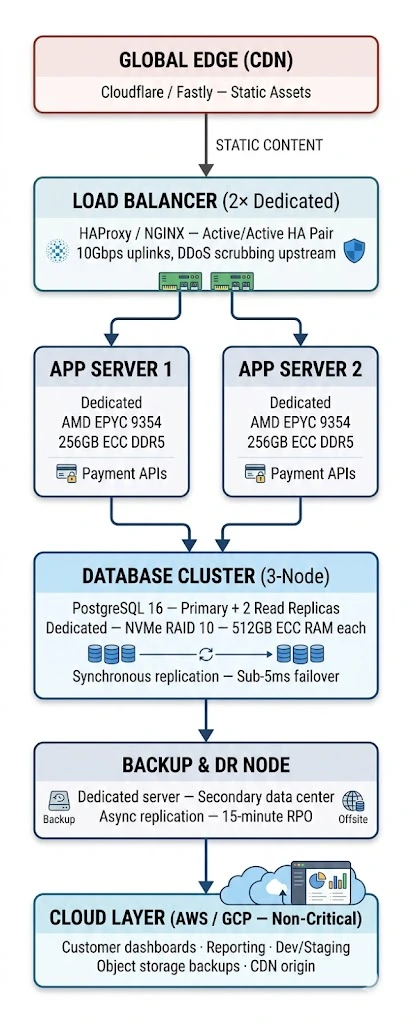
This architecture achieves 99.99% uptime through active/active load balancing, database cluster redundancy with synchronous replication, and an independent DR node in a separate data center. The cloud layer handles non-critical workloads at lower cost without introducing risk to transaction processing.
Must-Have Features When Choosing a Dedicated Server For FinTech
- Multi-layer security protocols: Require all 4 of these: DDoS mitigation at the network edge, hardware firewall with custom rule sets, intrusion detection and prevention systems (IDS/IPS), and full-disk AES-256 encryption. A dedicated server with DDoS protection ensures maximum resilience against attacks, and HostNoc includes advanced DDoS protection across all dedicated server plans.
- Low-latency, high-speed connectivity: Verify the provider offers multiple Tier-1 upstream carriers for route redundancy, BGP routing for optimal path selection, and the ability to provision direct cross-connects to financial exchange colocation facilities. Providers with New York data centers are particularly relevant for US financial applications. HostNoc’s New York dedicated servers offer low-latency routing optimized for financial workloads in the northeastern US.
- Compliance certifications: Request the provider’s PCI-DSS Attestation of Compliance (AoC), GDPR Data Processing Agreement (DPA), and SOC 2 Type II audit report. Providers without current certifications transfer the full compliance burden to your team.
- Customizable hardware configurations: The ability to specify exact processor models, RAM quantities, storage types, and network cards is essential for FinTech workload optimization. Fixed hardware tiers limit both performance tuning and cost efficiency.
- 24/7 managed support and monitoring: Financial markets run continuously. Require sub-15-minute critical incident response SLAs, proactive hardware monitoring with automated alerts, and on-site NOC coverage for physical intervention. HostNoc’s server management service provides 24/7 NOC monitoring with real-time alerting across all managed plans.
Real-World Use Cases of Dedicated Servers in FinTech
High-Frequency Trading (HFT) Platforms: HFT algorithms execute millions of orders per second by analyzing order books and price feeds in real time. A dedicated server colocated near an exchange matching engine achieves round-trip latency of 50–100 microseconds. The equivalent cloud instance in a remote data center introduces 10–50 milliseconds of latency, a 100× to 500× performance gap that makes cloud infrastructure non-competitive for live HFT workloads.
Payment Gateways: Payment gateways process cardholder data and maintain PCI-DSS compliance at all times. They handle millions of transactions daily, each requiring authorization, fraud scoring, and clearing in under 300 milliseconds. Dedicated servers deliver the isolation required for PCI-DSS, the throughput required for transaction volume, and the uptime required for merchant SLA compliance.
Financial Analytics and Risk Modeling: Risk models and fraud detection engines process terabytes of transaction history to produce real-time insights. These CPU-intensive, memory-hungry workloads run parallel computation across dozens of cores. Dedicated servers with high-core-count AMD EPYC processors and large ECC RAM pools handle these workloads without the resource contention that degrades cloud performance during peak compute periods. HostNoc’s dedicated servers for big data analytics cover the architecture patterns that financial analytics workloads share with broader big data applications.
Blockchain and Crypto Exchanges: Crypto exchanges require servers that validate transactions, maintain consensus nodes, and serve real-time order books continuously. The 24/7 nature of crypto markets, combined with volatility-driven traffic spikes, makes dedicated servers the standard choice. Dedicated servers also provide the network isolation that blockchain node security requires, making them equally suitable for specialized use cases like a dedicated server for crypto mining bots, ensuring consistent performance and security.
Digital Banking and Neobanks: Neobank core banking systems require database servers with extremely high IOPS and low-latency connectivity to payment networks like SWIFT and SEPA. A dedicated server with NVMe storage delivers 500,000+ IOPS, exceeding what cloud database instances provide at comparable cost points for sustained high-frequency financial workloads.
Split Expense and B2B Finance Apps: Split expense and B2B payment platforms manage shared financial transactions across multiple parties. They face predictable but high-demand load patterns: payroll runs, end-of-month settlements, tax filing deadlines. Dedicated servers sustain consistent performance during these peaks without the auto-scaling delays cloud environments introduce.
FinTech Compliance: What Regulations Your Server Must Support
|
Regulation |
Scope |
Key Infrastructure Requirements |
| PCI-DSS v4.0 | Systems handling cardholder data | Network segmentation, encryption at rest and in transit, access logging, quarterly vulnerability scanning |
| GDPR | EU/EEA personal data | Data residency controls, erasure capability, 72-hour breach notification |
| SOC 2 Type II | SaaS/FinTech serving US enterprise clients | Security, availability, processing integrity, confidentiality, privacy controls |
| MiFID II | EU investment firms and trading venues | Transaction reporting, 5-year data retention, real-time monitoring |
| DORA | EU financial entities (active from Jan 2025) | ICT risk management framework, incident reporting within 4 hours, resilience testing, third-party oversight |
DORA is now active. The EU’s Digital Operational Resilience Act has been enforceable since January 2025. It requires all EU-regulated financial entities to demonstrate ICT risk management frameworks, conduct regular resilience testing, and report major ICT incidents within 4 hours of classification. Dedicated server providers with SOC 2 Type II and ISO 27001 certifications significantly simplify DORA compliance documentation. EU-based FinTech companies without a DORA-compliant infrastructure posture now face supervisory scrutiny in addition to the existing GDPR and PCI-DSS frameworks.
Benefits of Using a Dedicated Server for FinTech Business
Improved customer trust: Enterprise partners and regulated financial institutions audit vendors’ security infrastructure before onboarding. Dedicated server infrastructure with certifiable compliance controls is a demonstrable trust signal that wins contracts competitors on shared infrastructure cannot match.
Lower total cost of ownership over 3+ years: The upfront cost of dedicated servers is higher. Over 3 years, however, the calculus changes: a single regulatory fine for a PCI-DSS compliance failure starts at $5,000–$100,000 per month, depending on severity. A GDPR enforcement action for a data breach starts at €100,000 for minor violations and reaches €20 million for serious infractions. One major breach averaging $6 million in the financial sector eliminates any cost argument for shared infrastructure.
Seamless global operations: Dedicated server providers with global data center networks enable FinTech companies to expand internationally without rebuilding infrastructure. Regional data centers satisfy local data residency requirements while maintaining consistent performance across geographies. HostNoc’s guide on local vs global web hosting explores the strategic tradeoffs of data center location for internationally operating businesses.
Competitive performance advantage: In algorithmic trading, payment processing, and real-time credit scoring, infrastructure performance directly shapes competitive position. Faster transaction processing, lower fraud detection latency, and higher uptime availability translate directly into revenue and customer retention.
How to Choose the Best Dedicated Server Provider for FinTech
- Verify compliance certifications first: Request the current PCI-DSS AoC, SOC 2 Type II report, and ISO 27001 certificate before engaging any provider for financial workloads.
- Map data center locations to your exchange and customer geography: A UK-based trading firm benefits from LD4-adjacent colocation. A US-based payment processor needs NY4 proximity or equivalent. Run latency tests on the provider’s infrastructure before committing.
- Test network performance independently: Use the provider’s Looking Glass tool or a trial server to measure real-world latency and throughput. Advertised specifications and real-world performance diverge significantly across providers.
- Read the SLA in full detail: A 99.99% uptime SLA allows approximately 52 minutes of downtime per year. Confirm the SLA covers network, power, and hardware, not just connectivity. Review penalty clauses: providers confident in their infrastructure offer meaningful credits.
- Assess hardware provisioning speed: When transaction volumes spike and new capacity is needed, the provider’s provisioning timeline determines your response time. Same-day or next-day hardware provisioning is the standard for enterprise-grade FinTech providers.
- Confirm 24/7 technical support with relevant experience: General hosting support teams are often unequipped to handle the urgency and specificity of financial infrastructure incidents. Look for providers with dedicated enterprise support tiers, sub-15-minute response SLAs, and documented FinTech client references.
For a detailed evaluation framework that covers hardware selection, managed vs. unmanaged options, and provider comparison, see HostNoc’s best dedicated server guide.
Conclusion
A dedicated server for FinTech is the infrastructure foundation that separates financial technology companies that scale securely from those that expose themselves to breach risk, compliance failure, and performance instability.
The decision is not binary. Early-stage products belong on the cloud or VPS. As compliance obligations grow and transaction volumes become predictable, the 5 core advantages of dedicated infrastructure, isolated security, regulatory compliance, real-time performance, customizable scalability, and enterprise reliability justify the investment. Most mature FinTech architectures combine dedicated bare-metal for core systems with cloud for elastic, non-critical layers.
For HFT firms, colocated dedicated servers are standard infrastructure. For payment processors, compliance obligations make shared hosting a legal liability. For neobanks and digital wallets, customer trust and uptime expectations scale with infrastructure quality.
The right dedicated server gives your FinTech business the performance to compete, the security to protect, and the compliance posture to operate in every regulated market you serve.
Serious hosting for serious businesses. No noise. No sharing. Just you and performance.
Cores
RAM
Storage
Location
Monthly Price
Link
Intel Atom C2750 2.4GHz 8c/8t
16GB DDR3
Main Storage: 1 x 1TB HDD
Paris, France
$27.95 /month
Buy Now
AMD Opteron 3365 2.3GHz 8c/8t
16 GB DDR3
Main Storage: 2 x 1 TB (HDD SATA)
Dusseldorf, Germany
$30.95 /month
Buy Now
Intel Xeon D-1531 2.2GHz 6c/12t
32 GB DDR4
Main Storage: 2 x 256 GB (SSD SATA)
Paris, France
$45.00 /month
Buy Now
Intel Xeon E3-1230 v2 3.3GHz 4c/8t
32 GB DDR3
Main Storage: 2 x 1 TB (SSD SATA)
Amsterdam, Netherlands
$54.99 /month
Buy Now
Frequently Asked Questions About a Dedicated Server for FinTech

What is a dedicated server in FinTech?
A dedicated server in FinTech is a physical server allocated exclusively to a single financial technology company, with no shared resources. It provides the security isolation, processing performance, and compliance control that payment gateways, trading platforms, and digital banks require to operate reliably at scale.
Why do most FinTech companies prefer dedicated servers over shared hosting?
Shared hosting places multiple companies on the same physical hardware, creating 3 critical problems for FinTech: resource contention degrades real-time performance, shared environments complicate PCI-DSS and GDPR compliance, and co-tenant vulnerabilities expand the attack surface for financial data breaches.
What is the difference between a dedicated server and a cloud server for FinTech?
A dedicated server provides exclusive physical hardware with no virtualization layer, delivering more predictable latency and direct compliance control. Cloud servers share physical resources across virtual machines, introducing overhead and variability. Many FinTech companies run hybrid architectures: dedicated for core trading and databases, cloud for non-latency-sensitive APIs and dashboards.
How much does a dedicated server for FinTech cost?
Dedicated server for FinTech range from $200–$500/month for entry-level configurations (single processor, 64GB RAM, 1Gbps port) to $2,000–$5,000+/month for enterprise HFT configurations (dual AMD EPYC processors, 512GB ECC RAM, NVMe arrays, 10Gbps port with exchange cross-connect). Managed services, DDoS protection, and compliance support add to the base cost.
What compliance certifications does a FinTech server provider need?
A FinTech dedicated server provider needs a current PCI-DSS v4.0 Attestation of Compliance, SOC 2 Type II audit report, and ISO 27001 certification as a minimum. EU-operating providers also require GDPR-compliant data processing agreements and, from 2025, DORA-compliant ICT risk management frameworks.
What hardware specifications does a FinTech trading server need?
A FinTech trading server requires a high-clock CPU (Intel Xeon Gold or AMD EPYC 9004 series), a minimum of 128GB ECC DDR5 RAM, NVMe PCIe Gen4 storage in RAID 10 configuration, a 10Gbps+ network port with redundant uplinks, and dual redundant power supplies. HFT platforms additionally benefit from CPU pinning, DPDK kernel bypass, and low-latency NICs like NVIDIA Mellanox ConnectX-7.
When should a FinTech startup NOT use a dedicated server?
Early-stage FinTech startups validating product-market fit, teams running low-traffic internal tools, and companies in rapid experimentation phases are typically better served by cloud or VPS infrastructure. Dedicated servers become the right choice when transaction volumes, compliance obligations, or latency requirements outgrow what shared and virtualized environments reliably deliver.
How do dedicated servers support high-frequency trading (HFT)?
Dedicated servers support HFT through 4 mechanisms: bare-metal CPU access eliminates virtualization latency; colocation in exchange-adjacent data centers minimizes physical network distance; 10Gbps+ direct peering bypasses public internet routing; and NVMe storage ensures transaction log writes complete without I/O delay. Advanced configurations add CPU pinning, DPDK, and low-latency NICs to reduce execution latency further.

Muhammad Osama
Muhammad Osama a qualified professional with ground-breaking experience in developing SEO campaigns, analytics, and monitoring the ranking in Google search pages. A clear communicator with an experience of digital marketing and improving brand search ranks.
Featured Post
Dedicated Server for Agencies: A Complete Guide
Agencies today manage multiple client websites, applications, and...

Sarmad Hasan
July 13, 2026
Does Borderlands 3 Have Dedicated Servers?
No. Borderlands 3 does not use dedicated servers. Multi player gaming sessions...

saad ullah
July 8, 2026
Data Center Market Share 2026: Hyperscalers vs. Colocation vs. Enterprise
The global data center industry is undergoing one of the most significant...
Sarmad Hasan
July 1, 2026