Blogs
Key Takeaways
- Public cloud platforms like Amazon Web Services and Microsoft Azure excel in scalability, flexibility, and rapid deployment, making them ideal for dynamic workloads and startups.
- Bare metal solutions from providers like IBM or Oracle Corporation deliver superior performance, control, and predictable costs, especially for high-performance or compliance-heavy environments.
- Your choice depends on workload type, cost predictability, compliance needs, and operational expertise. There is no one-size-fits-all answer, and hybrid models are increasingly common.
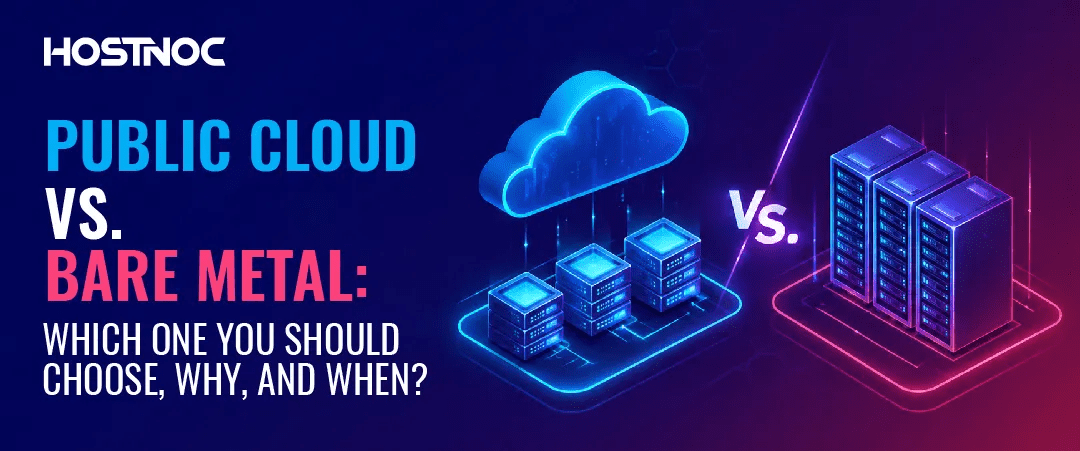
Modern businesses face a critical infrastructure decision: should they rely on flexible, shared environments like Google Cloud Platform or invest in dedicated hardware through bare metal servers? With increasing pressure to optimize performance, cost, and scalability, making the wrong choice can lead to inefficiencies, security risks, or wasted budget.
Imagine deploying a high-traffic application on a public cloud and suddenly facing unpredictable costs due to scaling spikes. Or, conversely, running a latency-sensitive workload on virtualized infrastructure and experiencing performance bottlenecks. These misalignments can hurt user experience, slow innovation, and impact revenue.
Understanding the nuanced differences between public cloud and bare metal infrastructure, along with when and why to use each, can help you make an informed, future-proof decision. This guide breaks down both options in detail to help you choose wisely.
What Is Public Cloud?
Public cloud refers to computing resources delivered over the internet by providers such as Amazon Web Services, Microsoft Azure, and Google Cloud Platform. These platforms offer virtual machines, storage, databases, and networking services on a pay-as-you-go basis.
Core Characteristics
- Multi-tenant architecture: Resources are shared among multiple users.
- Elastic scalability: Instantly scale up or down based on demand.
- Managed services: Includes databases, AI tools, and serverless computing.
- Global availability: Data centers distributed worldwide.
Key Technologies
Public cloud relies heavily on virtualization and containerization technologies like Docker and orchestration tools such as Kubernetes.
What Is a Bare Metal Server?
A bare metal server refers to a physical server dedicated to a single tenant. Unlike virtualized environments, there is no hypervisor layer, meaning applications run directly on hardware.
Providers like IBM, Oracle Corporation, and Equinix offer bare metal services in modern data centers.
Core Characteristics
- Single-tenant infrastructure: No resource sharing.
- Full hardware control: Customize CPU, RAM, storage, and networking.
- High performance: No virtualization overhead.
- Enhanced security: Isolation reduces the attack surface.
Public Cloud vs Bare Metal: Detailed Comparison
1. Public Cloud vs Bare Metal: Performance
Bare metal environments outperform public cloud in raw computing power because there is no virtualization layer. Workloads like high-frequency trading systems or large-scale databases benefit from this.
In contrast, public cloud platforms like Amazon Web Services offer optimized instances, but they still share underlying resources.
Verdict:
- Choose bare metal for maximum performance and low latency.
- Choose a public cloud for general-purpose workloads.
2. Public Cloud vs Bare Metal: Scalability
Public cloud is unmatched in scalability. Services from Microsoft Azure allow automatic scaling based on traffic, making it ideal for unpredictable workloads.
Bare metal requires manual provisioning, which can take hours or days.
Verdict:
- Public cloud wins for elastic scaling.
- Bare metal suits predictable workloads.
3. Public Cloud vs Bare Metal: Cost
Public cloud follows a consumption-based pricing model. While this is flexible, it can become expensive at scale if not managed carefully.
Bare metal typically involves fixed monthly costs, offering better predictability for long-term workloads.
Example:
Running a constant high-load application may be cheaper on bare metal than on Google Cloud Platform.
Verdict:
- Public cloud for short-term or variable workloads.
- Bare metal for steady, long-term usage.
4. Public Cloud vs Bare Metal: Security
Bare metal provides physical isolation, which is crucial for industries with strict compliance requirements (e.g., healthcare, finance).
Public cloud providers like Amazon Web Services invest heavily in security, but the shared responsibility model can introduce complexity.
Verdict:
- Bare metal for strict compliance and isolation.
- Public cloud for standard enterprise-grade security.
5. Public Cloud vs Bare Metal: Control and Customization
Bare metal gives complete control over hardware and software configurations. You can fine-tune performance at the BIOS or OS level.
Public cloud environments abstract much of this control in favor of ease of use.
Verdict:
- Bare metal for deep customization.
- Public cloud for ease and speed.
6. Public Cloud vs Bare Metal: Deployment Speed
Launching a server on Amazon Web Services takes minutes. Bare metal provisioning can take significantly longer.
Verdict:
- Public cloud for rapid deployment.
- Bare metal for planned infrastructure setups.
7. Public Cloud vs Bare Metal: DevOps and Ecosystem
Public cloud platforms integrate seamlessly with DevOps tools like Kubernetes and CI/CD pipelines.
Bare metal can support these tools, but requires more manual configuration.
Verdict:
- Public cloud for modern DevOps workflows.
- Bare metal for custom engineering environments.
When Should You Choose a Public Cloud?
Public cloud is the right choice if:
1. You Need Rapid Scalability
Startups and SaaS companies often rely on Microsoft Azure to scale quickly without upfront investment.
2. Your Workload Is Variable
E-commerce platforms during seasonal spikes benefit from cloud elasticity.
3. You Want Managed Services
Services like AI, analytics, and serverless computing are readily available on Google Cloud Platform.
4. You Have Limited Infrastructure Expertise
Cloud platforms reduce the need for hardware management.
When You Should Choose Bare Metal?
Bare metal is ideal if:
1. You Require High Performance
Applications like gaming engines or real-time analytics benefit from dedicated servers.
2. You Need Predictable Costs
Enterprises running consistent workloads can optimize costs with providers like IBM.
3. You Have Strict Compliance Requirements
Industries handling sensitive data often prefer isolated environments.
4. You Need Full Control
Custom OS kernels or specialized hardware configurations are easier on bare metal.
Public Cloud vs Bare Metal: Hybrid Approach
Many organizations combine both models in a hybrid architecture. For example:
- Use Amazon Web Services for front-end scalability.
- Use bare metal from Equinix for backend databases.
This approach balances flexibility and performance while optimizing costs.
Public Cloud vs Bare Metal: Real-World Use Cases
Public Cloud Example
A startup building a mobile app uses Google Cloud Platform for hosting, scaling automatically as user demand grows.
Bare Metal Example
A financial institution uses dedicated servers from Oracle Corporation to ensure compliance and ultra-low latency.
Public Cloud vs Bare Metal: Final Verdict
Public Cloud vs Bare Metal. Choosing between the two isn’t about which is “better,” it’s about which is right for your specific use case.
Public cloud platforms like Amazon Web Services dominate in flexibility, innovation, and speed. Bare metal solutions from providers like IBM excel in performance, control, and predictability.
As infrastructure needs evolve, many organizations are moving toward hybrid models that combine the strengths of both. The smartest strategy is to align your infrastructure choice with your business goals, technical requirements, and long-term growth plans.

Featured Post
Bare Metal vs Cloud Computing: A Comprehensive Comparison
Key Takeaways Bare metal servers deliver maximum performance, full hardware control, and...

Sarmad Hasan
July 8, 2026
Managed vs. Unmanaged VPS: A Total Cost of Ownership (TCO) Breakdown
Choosing between managed and unmanaged VPS hosting is not just a technical...
Sarmad Hasan
July 3, 2026
Windows VPS Hosting vs Linux VPS Hosting: A Detailed Comparison
Key Takeaways VPS hosting provides dedicated resources and full server control, offering...
Sarmad Hasan
June 26, 2026