Blogs
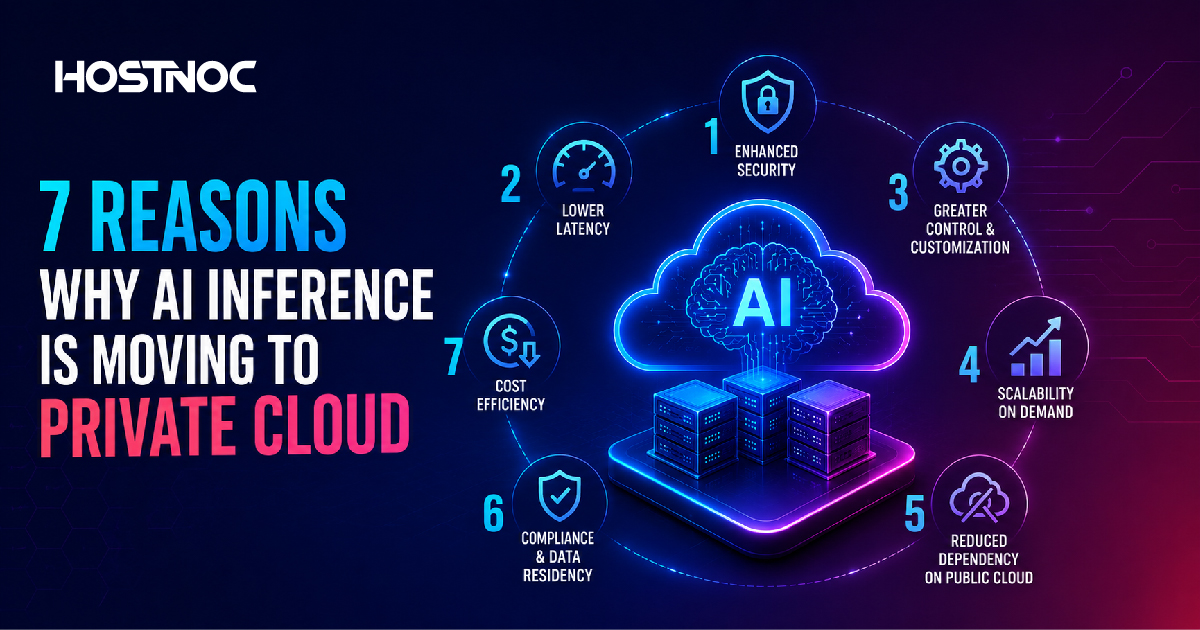
Enterprises are moving beyond AI experimentation and into large-scale production deployments, a significant shift is taking place in cloud strategy. Organizations that initially relied on public cloud platforms for AI development are increasingly moving AI inference workloads to private cloud environments.
According to a survey of 1,800 senior IT decision-makers conducted by Radius Tech on behalf of Broadcom, private cloud adoption for AI workloads is accelerating. The study found that only 41% of enterprises are now using public clouds for inference workloads, down from 56% a year earlier, while private cloud usage for AI inference has risen to 56%.
Broadcom describes this as an “AI tipping point” that is reshaping enterprise infrastructure decisions.
7 Reasons Why AI Inference Is Moving to Private Cloud
Here are seven reasons why AI inference is moving to private cloud.
1. Security and Compliance Have Become the Top Priority
Cloud costs dominate discussions about AI deployment, the survey reveals that security and compliance are the most influential factors driving infrastructure decisions.
When asked what most determines where workloads run:
- 32% selected security and compliance
- 15% chose data sovereignty and control
- 14% cited performance and latency
- 14% pointed to integration with existing systems
- 12% selected cost
- 12% selected speed of deployment and scalability
These findings show that organizations increasingly prioritize risk management and governance over pure cost considerations.
As AI systems gain access to sensitive enterprise data, organizations want greater oversight of how information is stored, processed, and protected.
2. Data Sovereignty Requirements Are Growing
Data sovereignty has emerged as a major concern, particularly for organizations operating outside the United States.
The survey found that 15% of enterprises consider data sovereignty and control the most important factor in workload placement decisions.
According to ABI Research analyst Michela Menting:
“With the largest public cloud providers being US-based, there is concern in the rest of the world for data protection that meets local regulations.”
As governments introduce stricter data residency and privacy requirements, enterprises are seeking environments where they can maintain greater control over where data resides and how it is processed.
Private clouds often provide clearer governance frameworks for meeting these obligations.
3. AI Inference Needs to Be Closer to Enterprise Data
AI training and AI inference have different infrastructure requirements.
Many organizations initially used public clouds to train models and run pilot projects. However, production inference workloads often need direct access to enterprise data sources.
Prashanth Shenoy, CMO and Vice President of Marketing for VMware Cloud Foundation at Broadcom, explained:
“Now that the majority of large-scale enterprise customers are done doing that, they want the models to be closer to where the data is and where the data is generated.”
He added:
“And that is in their own on-premise private cloud environment.”
Keeping AI models close to operational data can reduce complexity, improve governance, and streamline business processes.
4. Predictable AI Costs Matter More Than Ever
Generative AI and agentic AI applications are introducing new infrastructure challenges.
According to the survey, 62% of IT leaders are either “very” or “extremely” concerned about generative AI and agentic AI infrastructure costs.
Inference workloads can run continuously and at massive scale, creating unpredictable consumption patterns in public cloud environments. Agentic AI systems can further amplify costs by increasing interactions with large language models.
Private cloud environments offer organizations more predictable spending models, helping them avoid unexpected cost overruns while maintaining performance.
5. Enterprises Are Repatriating Workloads from Public Clouds
The movement toward private infrastructure is not limited to AI.
The study found that:
- 50% of enterprises have already repatriated some workloads from public clouds
- This is up from 35% in 2025
- Another 33% are actively considering repatriation
At the same time, 72% of enterprises plan to increase private cloud spending over the next three years, compared with 51% in the previous year’s survey.
These figures suggest a broader reevaluation of cloud strategies as organizations seek better alignment between performance, governance, and economics.
6. Performance and Latency Requirements Are Increasing
AI applications are becoming more integrated into mission-critical business processes where speed matters.
The survey found that 14% of respondents consider performance and latency the most important factor in determining workload placement.
Inference workloads often require rapid access to large datasets, specialized accelerators, and low-latency networking. Hosting these workloads within private cloud environments can reduce delays associated with moving data between enterprise systems and external cloud services.
As AI becomes embedded in customer experiences, operational systems, and real-time decision-making processes, latency optimization becomes increasingly important.
7. Enterprises Want Greater Control Over AI Infrastructure
Control remains one of the strongest arguments for private cloud adoption.
According to the survey, enterprises are highly concerned about data protection, privacy, security, and operational control. AI systems introduce additional governance requirements because they process large datasets, rely on expensive accelerators, and require specialized networking and security controls.
Dell’Oro Group analyst Mauricio Sanchez summarized the changing landscape:
“The old assumption that every workload eventually moves to public cloud has broken down.”
He further noted:
“If a company is running steady AI inference against sensitive data, wants more control over where data and models live, or needs predictable economics, a private cloud can look much better than it did a few years ago.”
For many organizations, private clouds now offer the combination of governance, visibility, and operational control needed to support enterprise AI at scale.
The Bottom Line
The enterprise AI market is entering a new phase. While public clouds remain valuable for AI experimentation, training, and highly variable workloads, organizations are increasingly choosing private clouds for production AI inference.
The numbers tell the story:
- Public cloud usage for AI inference fell from 56% to 41% year over year.
- Private cloud usage for AI inference reached 56%.
- 72% of enterprises plan to increase private cloud spending.
- 62% are highly concerned about AI infrastructure costs.
- 50% have already repatriated workloads from public clouds.
Security, compliance, data sovereignty, performance, and operational control—not just cost—are driving this shift. As AI becomes central to business operations, enterprises are finding that private cloud environments provide the governance, predictability, and proximity to data required for long-term success.
Why do you think AI inference is moving to private cloud? Share it with us in the comments section below.

Featured Post
Self-Hosted n8n vs Cloud n8n: Which Option Is Right for Your Automation Needs?
Self-hosted vs cloud n8n is a decision every growing business eventually has...

Faizan Irfan
August 7, 2026
Cloud for Finance: Everything You Need To Know
Key Takeaways Cloud for finance refers to both cloud-based financial systems and...

Sarmad Hasan
July 6, 2026
Cloud for Startup: A Comprehensive Guide
Key Takeaways Cloud computing enables startups to scale rapidly without heavy upfront...
Sarmad Hasan
June 12, 2026