Blogs
Key Takeaways
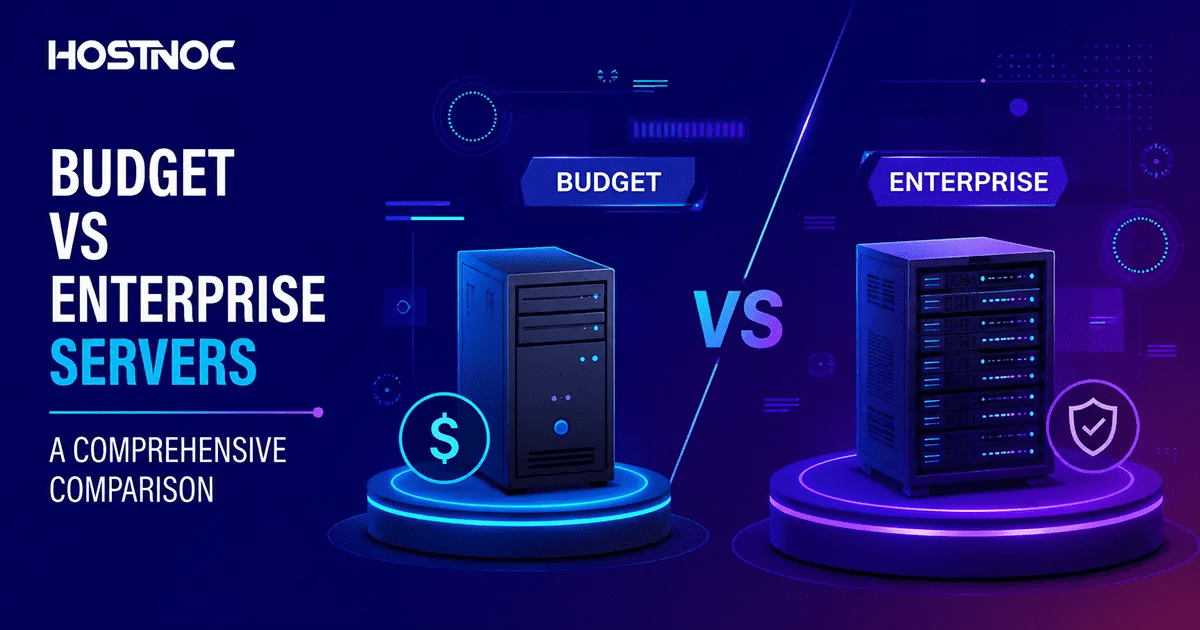
- Budget servers are cost-effective for small to medium workloads, while enterprise servers prioritize scalability, redundancy, and performance at a significantly higher cost.
- Enterprise-grade hardware from companies like Dell Technologies and Hewlett Packard Enterprise offers advanced reliability features that budget options often lack.
- Choosing between them depends on workload criticality, uptime requirements, and long-term growth not just upfront price.
Many businesses struggle to choose between budget and enterprise servers, often focusing only on upfront costs rather than long-term value. This can lead to costly downtime, poor performance under load, or overpaying for features that aren’t needed. A startup running heavy workloads on entry-level hardware might face crashes, while a small business overspending on enterprise gear may waste capital. Understanding the real differences between budget and enterprise servers across performance, scalability, reliability, and cost helps you make a smarter, future-proof decision.
What Are Budget Servers?
Budget servers are low-cost, entry-level machines designed for basic workloads and small-scale operations.
Budget servers typically use consumer-grade or entry-level server hardware. Examples include systems powered by processors like Intel Xeon E series or AMD EPYC 4004 series. These are often used for:
- Small business applications
- Development and testing environments
- Light web hosting
They offer decent performance at a lower price point but lack advanced redundancy and scalability features.

What Are Enterprise Servers?
Enterprise servers are high-performance systems built for mission-critical workloads requiring maximum uptime, scalability, and reliability.
Enterprise servers are designed by companies like Lenovo, Cisco, and IBM. They often include:
- Multi-socket CPUs like Intel Xeon Scalable processors
- Large ECC memory support
- Redundant power supplies and cooling systems
They are commonly used in:
- Data centers
- Financial systems
- Cloud infrastructure platforms
Budget vs Enterprise Servers: Core Differences
Here are some of the key differences between Budget vs Enterprise Servers.
1. Budget vs Enterprise Servers: Performance
Enterprise servers deliver significantly higher and more consistent performance under heavy workloads.
Budget servers are suitable for moderate workloads but can bottleneck under high concurrency. Enterprise systems, especially those optimized for Cloud Computing, handle virtualization, databases, and large-scale applications with ease.
2. Budget vs Enterprise Servers: Reliability & Uptime
Enterprise servers are built for near-zero downtime; budget servers are not.
Enterprise systems include:
- ECC (Error-Correcting Code) memory
- RAID configurations
- Hot-swappable components
These features reduce the risks of failures during critical operations, unlike most budget servers.
3. Budget vs Enterprise Servers: Scalability
Enterprise servers scale easily; budget servers have limited expansion capacity.
Enterprise hardware supports:
- Multiple CPUs
- High RAM ceilings (hundreds of GBs or more)
- Expansion through clustering
Budget servers are typically limited in RAM slots, PCIe lanes, and CPU upgrades.
4. Budget vs Enterprise Servers: Cost
Budget servers are cheaper upfront; enterprise servers cost more but offer better long-term value.
- Budget servers: Lower initial investment
- Enterprise servers: Higher upfront cost, but reduced downtime and better ROI over time
5. Budget vs Enterprise Servers: Use Cases
| Category | Budget Servers | Enterprise Servers |
| Small Business | Ideal | Overkill |
| Startups | Good starting point | Only if scaling fast |
| Data Centers | Not suitable | Essential |
| Mission-Critical Apps | Risky | Required |
Budget servers are best for low-risk, smaller-scale environments, while enterprise servers are designed for high-demand, mission-critical operations. For small businesses and startups, budget servers provide enough performance for everyday tasks like file storage, internal applications, and basic hosting. They’re cost-efficient and practical when workloads are predictable and downtime isn’t catastrophic. However, as soon as a business begins scaling rapidly or handling sensitive transactions, the limitations of budget hardware become more apparent.
On the other hand, enterprise servers dominate in environments where performance consistency, uptime and scalability are non-negotiable. Data centers and large-scale platforms, often built around principles of cloud computing, require systems that can handle thousands of concurrent operations without failure. These servers are engineered with redundancy and advanced resource management, making them essential for industries like finance, e-commerce, and SaaS. In such cases, even a few minutes of downtime can translate into significant financial loss, which justifies the higher investment.
Ultimately, the decision isn’t about which server is “better,” but which is appropriate for the workload and risk level. Budget servers work well as a starting point or for non-critical applications, while enterprise servers are necessary when reliability, scalability, and performance directly impact business success.

Conclusion
Budget vs enterprise servers isn’t just about price; it’s about aligning infrastructure with business needs. While budget servers offer a practical entry point, enterprise systems deliver the resilience and scalability required for long-term success.
If you’re planning for growth, investing early in enterprise-grade infrastructure from trusted vendors like Dell Technologies or Hewlett Packard Enterprise can prevent major bottlenecks later.
Frequently Asked Questions

Which is better for a small business?
Budget servers are usually the better choice for small businesses.
They provide sufficient performance for typical workloads like file sharing, email hosting, and small databases. Enterprise servers are only justified if uptime and scalability are critical from day one.
Are enterprise servers worth the cost?
Yes, if your operations depend on uptime, performance, and scalability.
For industries like finance, healthcare, or SaaS platforms, downtime can cost thousands per minute. Enterprise systems justify their price through reliability and performance guarantees.
Can a budget server be upgraded to an enterprise level?
No, not fully. While you can upgrade RAM or storage, budget servers lack architectural features like multi-socket support, advanced redundancy, and high-end chipsets found in enterprise hardware.
What industries require enterprise servers?
Industries with mission-critical workloads require enterprise servers.
These include:
- Banking and finance
- E-commerce platforms
- Cloud service providers
- AI and big data companies
These sectors often rely on technologies tied to Artificial Intelligence and high-performance computing.
How do I choose between the two?
Choose based on workload criticality, growth expectations, and downtime tolerance.
Ask yourself:
- How costly is downtime?
- Will workloads scale rapidly?
- Do I need redundancy?
If the answer to these questions leans toward high risk or growth, enterprise servers are the safer choice.

Featured Post
Bare Metal vs Cloud Computing: A Comprehensive Comparison
Key Takeaways Bare metal servers deliver maximum performance, full hardware control, and...

Sarmad Hasan
July 8, 2026
Managed vs. Unmanaged VPS: A Total Cost of Ownership (TCO) Breakdown
Choosing between managed and unmanaged VPS hosting is not just a technical...
Sarmad Hasan
July 3, 2026
Windows VPS Hosting vs Linux VPS Hosting: A Detailed Comparison
Key Takeaways VPS hosting provides dedicated resources and full server control, offering...
Sarmad Hasan
June 26, 2026